
Technical Installation Guide · Drive Systems
Planetary Gearbox Torque Arm Installation: 7 Rules That Determine Whether Your Hollow Shaft Drive Lasts 10,000 Hours or 2,000
The planetary gearbox torque arm installation is the most commonly incorrectly executed mechanical installation in the industrial drive systems market. A hollow shaft planetary gearbox mounted on a conveyor head shaft with a torque arm restraining the housing appears deceptively simple — yet the majority of premature hollow shaft gearbox failures are directly attributable to errors in the torque arm mounting, not to gearbox quality or specification. These seven rules eliminate the most common errors and ensure your drive achieves its full design life of 10,000+ operating hours.
Why the Torque Arm Is the Most Critical Component in a Hollow Shaft Drive Installation
A hollow shaft gearbox torque arm serves one purpose: to react the output torque from the gearbox housing into a fixed structural point. When the motor drives the gearbox input shaft, the reaction torque (equal and opposite to the output torque) acts on the gearbox housing — trying to rotate it in the opposite direction to the motor. The hollow shaft connection to the driven shaft prevents translation but not rotation of the housing. The torque arm is the structural element that resists this rotation.
If the torque arm is incorrectly positioned, incorrectly loaded, or allows elastic movement under torque peaks, the gearbox housing deflects slightly during each torque cycle. This cyclic deflection imposes a bending load on the hollow output bore that the bore was not designed to carry. Over 1,000–3,000 hours of cyclic loading, this bending stress initiates fatigue cracking at the bore-to-planet stage interface — the exact failure mode that appears as “unexplained” premature failure in incorrectly installed hollow shaft drives. In a properly installed system, the torque arm allows the housing to rotate through a small angle (typically 1–2°) within the rubber bush compliance, then stops — this small rotation is absorbed by the bush, not transmitted to the hollow shaft bore.
The gearbox reaction arm load is always equal to the output torque divided by the torque arm length. A gearbox producing 10,000 Nm of output torque with a 500 mm torque arm imposes 20 kN at the torque arm pivot point. The structural element at that pivot point — whether a bolt, a bracket weld, or a pin — must be rated for this load under the full range of operating conditions including shock events at 2–3× the continuous torque. Engineering the pivot point for 2.5× the calculated steady-state force is standard practice.
7 Installation Rules — Do and Don’t for Every Torque Arm Installation
Rules 5–8 — Essential Checklist for Long-Term Reliability
Rule 5
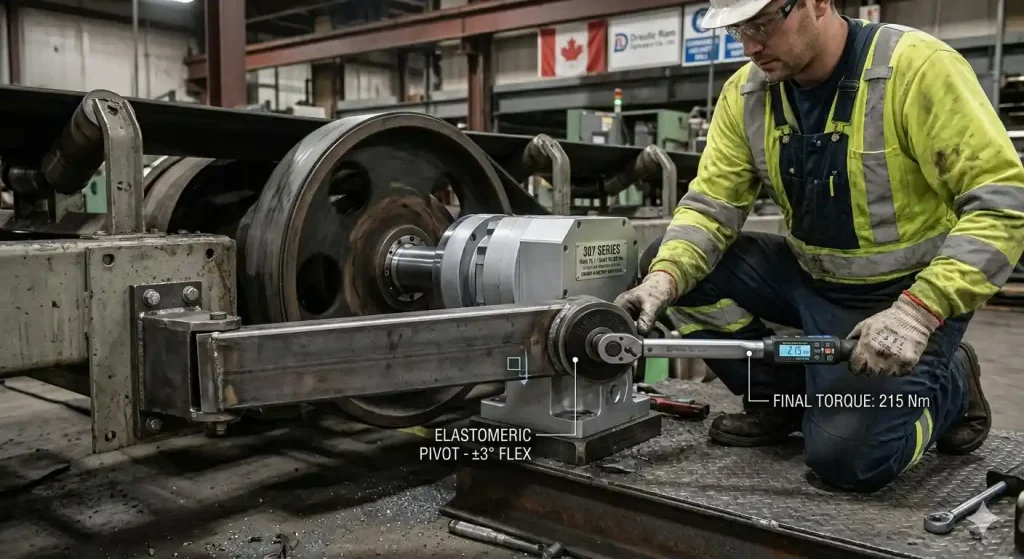
Retorque the torque arm pivot fastener after the first 100 operating hours. Thermal expansion at initial run-in relaxes the fastener torque by 15–25% in the first operating cycle. A retorque event at 100 hours re-establishes the correct clamping force and prevents the pivot from developing fretting under the now-loose fastener. Use a torque wrench set to the value specified in the gearbox installation manual — typically 150–250 Nm for M20 pivot fasteners.
Rule 6
Allow the torque arm to float freely — never weld or rigidly fix both ends. One end connects to the gearbox housing; the other connects to the fixed structure via the pivot pin. The pivot pin end must be free to rotate (within the rubber bush limits) — welding the torque arm rigid at both ends eliminates the elastic compliance and converts the torque arm into a rigid bending restraint, causing the exact housing distortion the torque arm was meant to prevent. If the machine frame does not provide a suitable mounting point, fabricate a bracket that bolts to the frame — never weld the torque arm directly to the frame structure.
Rule 7
Inspect the rubber bush for cracking at every 2,000-hour service. The rubber bush is a wear item. A cracked or hardened bush no longer provides the elastic compliance that protects the hollow shaft bore. Replace the bush at the first sign of surface cracking — bush replacement is a 30-minute task; hollow shaft bore repair or gearbox replacement is a 4–8 hour task. Replacement bushes are available from our parts department with the correct Shore hardness for your torque range.
Rule 8
Do not use the torque arm as a lifting point during gearbox installation. The torque arm bracket is designed for pure torque reaction in service, not for the combined bending moment + shear force of a lifting sling. Using the torque arm as a lifting point can permanently deform the bracket or initiate a weld crack that does not fail immediately but propagates under operating torque over the first 500–1,000 hours. Use the designated lifting lugs on the gearbox housing or a sling around the gearbox body — never the torque arm bracket.
Related Product Recommendations — Torque Arm Installation Components
A successful torque arm installation requires quality components beyond the gearbox itself. We supply and recommend the following items for new installations or field retrofits.
- Elastomeric Torque Arm Bushes (Shore A 70–80): Replacement rubber bushes for all standard torque arm pivot sizes (20 mm, 25 mm, 30 mm pin diameters). Supplied as a pair (upper and lower) with hardened steel washers. Also available in high-temperature FKM compound for installations above 80°C ambient.
- Torque Arm Bracket Kits (Bolt-On): Fabricated steel brackets for mounting the torque arm to existing machine frames when no suitable pivot point exists. Available in 300 mm, 500 mm, and 700 mm arm lengths with pre-drilled mounting holes for M16–M24 bolts. Rated to 30 kN continuous / 75 kN peak.
- Hollow Shaft Shrink Discs (Replacement): Shrink disc assemblies for hollow shaft gearboxes that have experienced fretting or wear at the original shrink disc interface. Supplied with torque wrench tightening specification and anti-seize compound for the threads. Available in shaft diameters from 40 mm to 160 mm.
- Torque Arm Installation Tool Kit: Includes a digital torque wrench (200–500 Nm range), seal driver for the output shaft seal, rubber bush installation press tool, and a copy of our 24-page torque arm installation field guide with worked examples for common conveyor and agitator drives.
✔ All components available individually or as a bundled installation kit. Quotations within 24 hours with worldwide shipping. Installation drawings provided free of charge for all gearboxes ordered with a torque arm bracket.
Conveyor Drive Torque Arm — Standard and Extended Configurations
The conveyor drive torque arm specification is the most common hollow shaft drive application. Head pulley drives on belt conveyors use hollow shaft right-angle or inline planetary gearboxes mounted on the pulley shaft, with a single torque arm reacting the drive torque into the conveyor frame structure. Our right angle planetary gearbox range is supplied with a standard torque arm bracket kit covering the most common installation configurations — 90° downward mount, 90° lateral mount, and floating mount for elevated conveyor installations. The 307 series right angle planetary gearbox includes a torque arm bracket as standard with each unit in the 3,000–30,000 Nm range, with a torque arm length selected to keep the pivot force below 15 kN for the rated continuous torque at 90° installation angle. Extended arm brackets (600–900 mm) are available for installations requiring lower pivot force due to structural constraints at the conveyor frame attachment point. Each gearbox is shipped with a full installation drawing showing the torque arm mounting position, pivot pin torque specification, and rubber bush part number.
Hollow Shaft Planetary Gearbox with Torque Arm — Bracket Included. Installation Drawings Provided.
Get a Torque Arm Drive Quote →
📧 [email protected] · Canada Planetary Gear Drive Co., Ltd · ISO 9001:2015 · Torque arm brackets and rubber bushes in stock for all gearbox sizes
editor:WM
Related Searches & Keywords
planetary gearbox torque arm installation · gearbox torque arm mounting · hollow shaft gearbox torque arm · torque arm bracket design · conveyor drive torque arm specification · planetary gearbox reaction arm · right angle planetary gearbox · 307 series right angle planetary gearbox · elastomeric torque arm bush · shrink disc replacement