
Maintenance & Technical
Core Keyword: planetary gearbox lubrication · Category: maintenance-technical
Planetary Gearbox Lubrication: Oil Types, Viscosity Selection, Change Intervals, and Maintenance Best Practices
Planetary gearbox lubrication is the single most important maintenance activity for long gearbox service life. More than 50% of all planetary gearbox failures can be traced directly to lubrication problems — incorrect oil type, contaminated lubricant, depleted additive package, or simply operating past the oil change interval. Yet lubrication is often the most neglected aspect of gearbox maintenance, because a gearbox can run for months on degraded oil before the failure mode becomes apparent (e.g., bearing scuffing, gear tooth pitting, or complete seizure). This guide covers oil selection, viscosity grades, synthetic vs mineral choices, change intervals, and the visual/analytical signs that lubrication is already compromised. Implementing a disciplined lubrication schedule is the lowest-cost, highest-return maintenance activity for any planetary gearbox installation.
How Lubrication Works in a Planetary Gearbox — Four Critical Functions
Gear oil in a planetary gearbox performs four functions simultaneously. Understanding each function helps explain why oil selection and maintenance are so critical:
- Load-carrying film formation (elastohydrodynamic lubrication): Under the pressure of gear tooth contact, oil is squeezed into a thin elastohydrodynamic (EHD) film between gear flanks. This film — typically 0.1–1.0 µm thick at operating temperature — prevents metal-to-metal contact and carries the entire load. Film thickness depends on oil viscosity, operating speed, and contact geometry. A minimum viscosity is required at operating temperature to maintain an adequate film. If the film thickness drops below the composite surface roughness of the gear teeth (typically 0.2–0.5 µm Ra), boundary lubrication occurs, and metal-to-metal contact begins — the start of wear.
- Heat removal (convective cooling): Oil absorbs heat from gear mesh friction and bearing friction (typically 2–6% of transmitted power), transporting it to the gearbox housing where it is dissipated to the environment. In splash-lubricated gearboxes (the most common configuration), this convective cooling is the primary thermal management mechanism. A gearbox running 10°C hotter than design will have its oil life cut by approximately 50% (Arrhenius rule of thumb).
- Corrosion protection (additive film): Oil additives (rust inhibitors, anti-oxidants, demulsifiers) form a protective molecular film on metal surfaces, preventing corrosion from moisture condensation and acidic oxidation products that form as the oil ages. When these additives are depleted, the gearbox becomes vulnerable to rust, particularly on bearing raceways and gear teeth flanks.
- Contamination management and debris transport: Gear oil suspends metallic wear particles generated by the gear mesh (typically 1–50 µm in size) and transports them to the sump where they settle or are captured by the drain plug magnet. The concentration and morphology of metallic particles in oil samples is a diagnostic indicator of gear and bearing wear rate. A sudden increase in particle count or the appearance of chips > 100 µm indicates active component failure.
Gear Oil Type Selection: ISO VG Grade, API Classification, and Application Matching
The primary viscosity specification for planetary gearbox oil is the ISO VG (Viscosity Grade) number, which specifies kinematic viscosity at 40°C in cSt (centistokes). This is the temperature at which most industrial gearboxes operate in steady-state condition. Common grades for industrial planetary gearboxes are:
| ISO VG Grade | Viscosity at 40°C | Typical Application | Operating Temp Range |
|---|---|---|---|
| ISO VG 68 | 61–75 cSt | Very high-speed, low-load (n > 6,000 RPM) | -10°C to +60°C |
| ISO VG 100 | 90–110 cSt | Small, high-speed gearboxes (n = 3,000–6,000 RPM) | 0°C to +70°C |
| ISO VG 150 | 135–165 cSt | Medium-speed servo gearboxes, general industrial | -5°C to +80°C |
| ISO VG 220 | 198–242 cSt | Heavy-load, lower-speed, conveyor and industrial drives | 0°C to +85°C |
| ISO VG 320 | 288–352 cSt | Very heavy-load, low-speed (< 500 RPM), high-torque | +5°C to +90°C |
| ISO VG 460 | 414–506 cSt | Extreme low-speed, high-ambient temperature (> 40°C) | +10°C to +100°C |
Critical rule: Always use the viscosity grade specified by the gearbox manufacturer, not a neighbouring grade. Using ISO VG 220 in a gearbox specified for ISO VG 150 increases churning losses and operating temperature by 5–10°C — particularly damaging at low temperatures where high-viscosity oils do not flow adequately on startup, potentially starving bearings for the first 30–60 seconds of operation. Conversely, using ISO VG 100 in a gearbox specified for ISO VG 220 reduces the EHD film thickness, increasing the risk of boundary lubrication and gear tooth wear.
Synthetic vs Mineral Gear Oil: When Does the Higher Cost Make Sense?
Mineral gear oils are derived from refined petroleum and are the most common and economical choice for gearboxes operating at moderate loads (≤ 80% of rated torque), normal temperatures (sump ≤ 80°C), and standard duty cycles. They are fully adequate for most industrial applications when changed at recommended intervals. Mineral oils contain natural anti-oxidants but are limited by their paraffinic or naphthenic base stock.
Synthetic gear oils — particularly PAO (polyalphaolefin) and ester-based synthetics — offer several performance advantages that justify their 3–5× higher cost in specific situations. The decision to switch to synthetic should be based on a clear business case, not general preference:
- Extended oil change interval (2–4× longer): Synthetic PAO oils can run 10,000–20,000 hours between changes vs 4,000–8,000 hours for mineral oils. In continuous-duty applications where oil changes require production stops (e.g., wind turbine gearboxes at 80m height, conveyor drives in inaccessible locations), the reduced change frequency often justifies the higher oil cost. The extended interval also reduces waste oil disposal volume.
- Low-temperature fluidity (pour point down to −50°C): Synthetic oils have significantly lower pour points (−50°C to −60°C vs −15°C to −30°C for mineral oils). For gearboxes starting in sub-zero environments — outdoor conveyors in Canada/Northern US, cold storage facilities (−20°C to −30°C), arctic wind turbines — synthetic oil ensures adequate lubrication on cold start without the viscosity spike that can starve bearings during warmup. A mineral oil at −20°C may be too thick to flow into the pump or bearing inlets, causing immediate damage.
- Higher thermal stability (oxidation resistance): At sump temperatures above 80°C, synthetic oils oxidize significantly more slowly than mineral oils, maintaining viscosity and additive effectiveness for longer periods. For gearboxes in high-ambient environments (foundries, paper mills, tropical climates), synthetic oil can extend service life by 2–3× compared to mineral oil.
- Improved energy efficiency (1–2% reduction in losses): The lower traction coefficient of PAO synthetics compared to mineral oils reduces gear mesh friction losses by approximately 1–2% at operating temperature. For a 50 kW continuous-duty gearbox, this represents 500–1,000 W of reduced heat generation — a measurable efficiency improvement that reduces both energy cost and cooling requirements.
- Better water separation and demulsibility: Synthetic PAO oils naturally resist water absorption and separate from water more readily than mineral oils. In applications where water ingress is a risk (outdoor gearboxes, pressure-washed equipment), synthetic oil reduces the likelihood of emulsification and the associated corrosion and lubricant degradation.
Check the E-Series Planetary Gearbox data sheet for manufacturer-recommended oil grades and the approved synthetic alternatives for each product size. Never mix synthetic and mineral oils — the additive packages can interact unpredictably, and the resulting mixture may have worse properties than either oil alone.
Oil Change Intervals: Standard Guidelines and Condition-Based Triggers
Oil change intervals depend on operating conditions. The following table provides general guidance — always consult the manufacturer’s service manual for the specific gearbox model. More frequent changes are required in severe conditions:
| Oil Type | Normal Conditions | Elevated Temp (80–95°C sump) | Heavy Shock / High Dust |
|---|---|---|---|
| Mineral ISO VG | 5,000–8,000 hours | 2,500–4,000 hours | 2,000–3,000 hours |
| Synthetic PAO | 10,000–20,000 hours | 6,000–10,000 hours | 4,000–6,000 hours |
| NSF H1 (food grade) | 4,000–6,000 hours | 2,000–3,000 hours | 2,000 hours |
Additionally, always change the oil under these conditions regardless of elapsed hours:
- Initial break-in (first 500 hours): Break-in oil contains metallic particles (iron, copper, chromium) from gear tooth and bearing surface conditioning. Change at 500 hours to remove these wear particles before they can cause abrasive wear.
- After any overtemperature event (sump > 100°C): High temperatures accelerate oxidation and deplete additives. Oil that has exceeded 100°C should be changed immediately, even if the hour meter shows low hours.
- After water ingress (milky or cloudy appearance): Water content above 0.2% (2,000 ppm) reduces load-carrying capacity and promotes rust. Water-contaminated oil must be changed — attempting to “dry out” the oil by heating is not effective for emulsified water.
- After any gearbox repair or major disassembly: Opening the gearbox exposes the oil to airborne contaminants and moisture. Always change the oil after reassembly.
How to Check and Change Planetary Gearbox Oil — Step-by-Step Procedure
- Check oil level (monthly or before each shift in critical equipment): Most planetary gearboxes have an oil level sight glass or dip stick. Check when the gearbox is at operating temperature (oil expanded to normal volume) with the unit in its normal mounting orientation. A low level indicates either consumption (which should not occur in a sealed gearbox — investigate seal condition if level drops) or the unit was never filled to the correct level. Top up with the same oil grade only — never mix grades or brands.
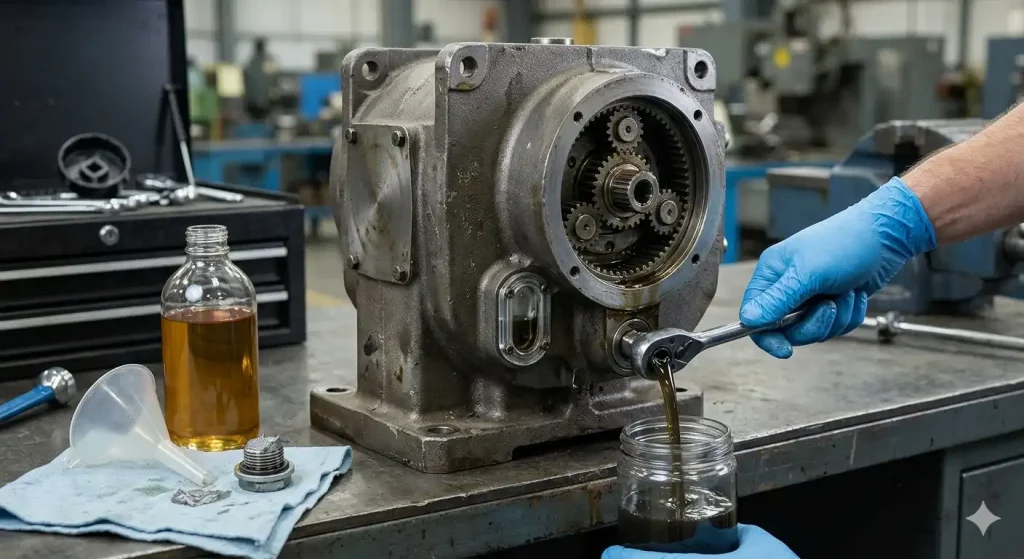
- Oil condition check (at each oil change and when abnormalities are suspected): Drain a small sample into a clean glass container. Fresh gear oil is typically amber to dark amber and clear. Reject oil that is: black (oxidized/overheated, additive depletion), milky white (water contaminated — typically > 0.5% water), containing visible metallic particles (gear or bearing wear — any visible particle > 50 µm is cause for investigation), or with a burnt smell (thermal degradation).
- Oil change procedure: Run the gearbox to operating temperature (oil less viscous = drains more completely and suspended particles are still in suspension). Stop the gearbox, remove the drain plug (with appropriate PPE — oil may be hot). Drain fully into a clean container. Inspect the drain plug magnet for particle accumulation — fine grey paste is normal; chips or distinct metallic flakes are abnormal. Flush with a light flushing oil (same viscosity grade as operating oil) if contamination is suspected. Reinstall drain plug with a new washer (crush washer or O-ring type — never reuse). Fill through the fill port to the correct level mark with the specified oil grade. Run briefly for 2–3 minutes, stop, and recheck level — add oil as needed.
- Used oil disposal: Do not mix gear oil with other fluids (hydraulic oil, engine oil, coolant). Contact a licensed used oil collection service. In many jurisdictions, pouring used gear oil down drains is illegal regardless of volume, with fines up to $10,000 per violation. Keep used oil in sealed containers labeled with the oil type and date.
Refer to the inline planetary gearbox service documentation for fill volumes and drain plug locations specific to each gearbox frame size. Fill volumes typically range from 0.05 L (small 40mm frame) to 4.0 L (large 180mm frame).
Grease-Lubricated vs Oil-Bath Planetary Gearboxes: Selection Considerations
Small planetary gearboxes (frame sizes below approximately 60 mm housing diameter) are often grease-lubricated rather than oil-bath. Grease lubrication simplifies the housing design (no drain plug, no sight glass, no vent plug required), enables any mounting orientation (grease stays in place where oil would drain away), and is sealed for life in many designs (no maintenance required for the service life of the gearbox).
However, grease-lubricated gearboxes have significant limitations compared to oil-bath units:
- Lower thermal capacity: Grease cannot convect heat to the housing as effectively as circulating oil. For continuous high-duty applications (e.g., servo drives running at > 50% rated torque continuously), a grease-lubricated gearbox may overheat where an oil-bath unit would run at normal temperature.
- No effective contamination removal: Wear particles remain in the grease at the contact points, causing abrasive wear. In oil-bath gearboxes, particles settle to the sump and are captured by the drain plug magnet.
- Difficult to verify fill condition: With no sight glass, there is no way to confirm the grease level or condition without disassembling the gearbox.
- Limited operating temperature range: Most gear greases are rated for -20°C to +80°C. Outside this range, the grease may separate (oil bleeding), thicken, or carbonize.
For continuous high-duty applications with small precision gearboxes, verify that the thermal rating is not exceeded before specifying a grease-lubricated unit. For demanding continuous applications, specify an oil-bath gearbox even in small frame sizes — the additional cost is justified by longer service life.
Related Products You May Need
⚙️ Oil Change Kits
Complete oil change kits including specified lubricant, new drain plug washer, fill port cap, and disposal bag. Available for all ISO VG grades.
🧪 Oil Sampling Kits
Pre-sterilized oil sampling bottles, chain-of-custody forms, and lab analysis services (viscosity, water content, particle count, additive depletion).
🔧 Drain Plug Magnets
Replacement high-strength neodymium drain plug magnets for capturing ferrous wear particles. Standard sizes for all gearbox frame dimensions.
📊 Sight Glasses
Replacement oil level sight glasses with temperature indicators. For gearboxes where the original sight glass has fogged or cracked.
Keep Your Planetary Gearbox Running at Full Performance
Proper lubrication is the foundation of long gearbox service life. Download our lubrication specification sheets for each product series, including approved oil grades, fill volumes, and change intervals. Contact our service team for a customized maintenance schedule based on your operating conditions.