
LHD Drive Architecture — How the Wheel Planetary Gearbox Fits in Underground Tramming
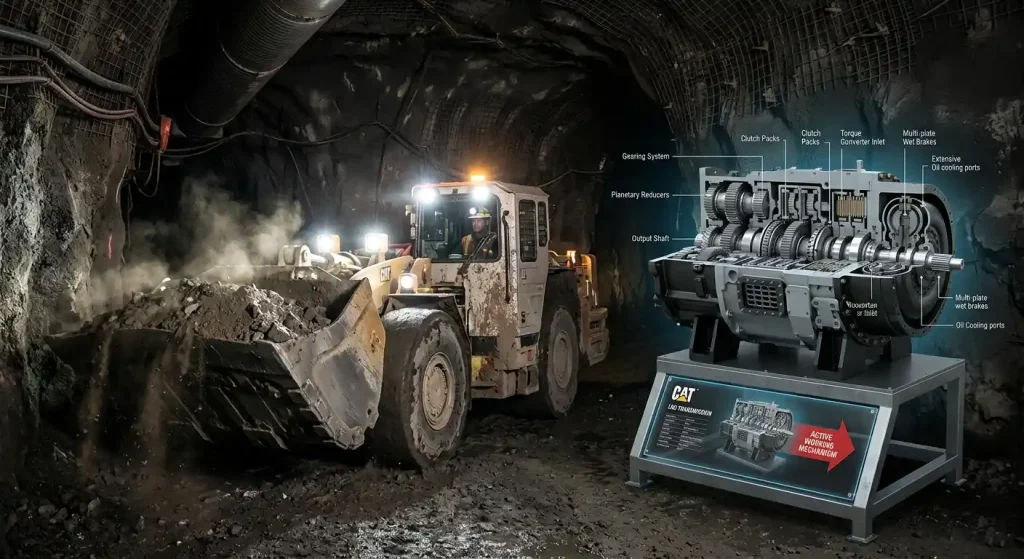
A load haul dump planetary wheel drive (LHD or Scooptram) is an articulated wheel loader designed exclusively for underground tunnel operation. The machine loads broken ore or waste rock from a blasted muck pile (Load), carries it along the tunnel (Haul), and tips it into an ore pass or underground crusher feed (Dump). The machine articulates at the centre frame joint to negotiate tight tunnel curves — minimum turning radius for a 10-tonne LHD is typically 8–10 metres inside radius, driven by the short wheelbase and the articulation angle of up to 40° each direction. This articulation places significant lateral thrust loads on the wheel hub gearboxes during loaded turns, requiring a high-capacity output bearing arrangement (typically tapered roller bearings with >150,000-hour L10 life).
Each wheel axle has its own planetary wheel drive gearbox integrated into the wheel hub — essentially a compact version of a large excavator track drive, adapted for the wheel-mounted configuration with a hollow output shaft that carries the wheel rim. The torque path in a modern hydrostatic LHD is: diesel engine → variable displacement pump → wheel motor (piston type) → planetary hub gearbox → wheel. The wheel planetary gearbox is the final torque amplification step, typically providing a 4–8:1 ratio reduction to convert the high-speed wheel motor output to low-speed high-torque wheel rotation. In hydrostatic LHDs, the wheel motor itself is a high-speed axial piston unit (max 4,000–5,000 rpm), so the planetary hub must reduce that speed while multiplying torque to achieve the wheel drawbar pull required for muck pile engagement — typically 35,000–60,000 N drawbar pull for a 15-tonne machine.
The LHD tram drive gearbox on larger machines (15–20 tonne class) uses 3-stage planetary hubs with output torques in the 50,000–120,000 Nm range per wheel position. The machine’s four wheel drives operate simultaneously during bucket fill — all four wheels spinning against the muck pile with maximum tractive effort, often with the bucket teeth penetrating the muck pile at full throttle. The simultaneous loading of all four hubs creates the highest sustained torque condition the gearboxes experience and is the primary design load for bearing life calculation. Unlike surface loaders, underground LHDs cannot rely on inertia to break into the pile — they must develop maximum torque from near-zero wheel speed, making the hub gearbox’s starting torque capacity critical.
Major LHD Models — Gearbox Reference Data & Underground Compatibility
| Model | Bucket Cap. | Wheel Torque (Nm) | Stages | Drive Type |
|---|---|---|---|---|
| Sandvik LH517 | 17 t | ~85,000 Nm | 3 | Hydrostatic |
| Epiroc ST14 (ex-Atlas Copco) | 14 t | ~70,000 Nm | 3 | Hydrostatic |
| Caterpillar R1700 | 15 t | ~75,000 Nm | 3 | Hydrostatic |
| Komatsu WX06 | 6 t | ~32,000 Nm | 2–3 | Hydrostatic |
| Sandvik LH410 (electric) | 10 t | ~52,000 Nm | 3 | Electric / hydrostatic |
Reference values only. Always confirm from machine service manual or gearbox nameplate before ordering replacement.
The Sandvik LH517 gearbox and the Atlas Copco Scooptram drive gearbox (now Epiroc ST series) are the two most widely deployed underground LHD wheel drives in Australian and Canadian hard rock mines. Both use a 3-stage planetary arrangement with a hollow output shaft that accepts the wheel rim mounting flange. The critical dimension that varies between brands is the input shaft spline (which interfaces with the hydrostatic wheel motor) and the wheel flange bolt circle. Sandvik typically uses a DIN 5480 spline; Epiroc uses a proprietary involute spline. Our S series planetary gearbox can be supplied with either spline configuration when the machine model and wheel motor part number are provided.
Underground LHD Gearbox Service — 500-Hour Oil Change is Non-Negotiable
The underground mining wheel reducer oil change interval on most LHD OEM service schedules is 1,000 hours. For machines operating in hard rock underground environments in Australia and Canada, where rock dust concentrations are high and shock loading is continuous, 500 hours is the correct interval. The reasoning: the shock loading from muck pile engagement generates metallic wear debris at a rate approximately 2× higher per hour than a surface wheel drive of equivalent torque class. Combined with higher ambient dust concentration in underground tunnels (shaft seals on LHD hubs are lip-type and cannot filter sub-5-micron rock dust), oil contamination accelerates dramatically faster underground. Analysis of used oil from 15-tonne LHD wheel hubs shows iron particle counts exceeding 200 ppm at 800 hours — the manufacturer’s alarm threshold for these gearboxes is 80 ppm.
The more common failure in the field is running the machine until hub failure occurs mid-shift in a remote underground level — at which point the machine may require partial disassembly to remove from the level, and production loss can run to 24–48 hours. Planned replacement at the oil analysis-indicated wear threshold prevents this unplanned scenario. The actual gearbox removal procedure for most Sandvik and Epiroc LHDs: wheel off (45 min), hub cap and bearing locknut removal (30 min), gearbox extraction using a purpose-built puller (1 hour), cleaning and inspection of the wheel motor spline (30 min), reassembly with new gearbox (1.5 hours), wheel refit (45 min). Total per hub: 4.5 hours for two technicians. Cost of unplanned failure mid-shift: 8–12 hours of lost production at an underground gold mine (A$25,000–40,000 per hour of downtime) plus emergency labour.
⛏️ Common failure modes in underground LHD planetary hubs:
- Thrust bearing collapse — caused by extended operation with contaminated oil. Symptoms: wheel wobble, metallic grinding when turning.
- Planetary pinion bearing seizure — from fine rock dust ingress past worn shaft seal. Symptoms: intermittent drive, then complete lockup.
- Ring gear tooth fracture — from shock load exceeding gearbox rating (typically when bucket hits a buried boulder at speed). No warning, instantaneous failure.
- Spline wear on input shaft — from micro-fretting due to insufficient lubrication of the wheel motor interface. Detected via oil analysis for molybdenum.
Related Product Recommendations — Complete Your LHD Drivetrain Ecosystem
An underground LHD wheel drive is only as reliable as the components surrounding the planetary hub. We supply and recommend the following complementary products, all validated for compatibility with our S series and inline planetary gearboxes in underground mining conditions.
Axial piston wheel motors (variable or fixed displacement) for hydrostatic LHD tram drive. Our recommended units feature integrated parking brake, speeds up to 5,000 rpm input to the planetary hub, and displacement ranges from 1,000–4,000 cc/rev. Direct bolt-on replacement for Eaton, Rexroth, and Poclain motors on Sandvik and Epiroc machines.
Forged steel wheel mounting flanges that bolt directly to the planetary hub output. Available in all common bolt patterns (10-hole, 12-hole, 16-hole) and pilot diameters to match LHD tyre rims (25″, 28″, 32″ rim sizes). Heat-treated to 300 HB minimum for underground abrasion resistance. Custom flange offsets available.
Spring-applied, hydraulically-released multi-disc brakes for direct integration with the planetary hub or wheel motor. Oil-immersed discs for high thermal capacity (up to 200 kJ per stop). Holding torque ratings from 8,000–40,000 Nm, suitable for 15–20 tonne LHDs. IP68 enclosure for underground water spray conditions.
✔ All three product categories are stocked for urgent underground mine delivery. Ask for a bundled LHD drivetrain kit (planetary hub + wheel motor + wet brake) for discounted mine fleet pricing. Quotations within 24 hours with mine site delivery to Australia, Canada, and South Africa.
For LHD wheel hub replacement in the 30,000–120,000 Nm class, our S series planetary gearbox provides the high-torque, high-service-factor units with IP67 sealing and shock load ratings to 5× nominal torque. For small LHD and underground utility vehicles (5,000–30,000 Nm), our inline planetary gearbox range covers the wheel hub configuration with the correct overhung load rating for underground wheel drive applications. Provide the LHD model, bucket capacity, and gearbox nameplate photograph for a confirmed specification within 24 hours.
Underground LHD Wheel Drive Gearbox — Shock-Rated, IP67, Quoted in 24 Hours
📧 [email protected] · Canada Planetary Gear Drive Co., Ltd · ISO 9001:2015 · Emergency LHD gearboxes available for Sandvik, Epiroc, Caterpillar · Mine site delivery
Related Searches & Keywords
underground LHD gearbox · load haul dump planetary wheel drive · LHD tram drive gearbox · Sandvik LH517 gearbox · Atlas Copco Scooptram drive gearbox · underground mining wheel reducer · S series planetary gearbox · inline planetary gearbox range · Epiroc ST14 wheel hub · Caterpillar R1700 planetary drive