
Technical Reference · Motor-to-Gearbox Interface
Planetary Gearbox Input Shaft: IEC Motor Connection, Key vs. Spline vs. Hollow Shaft — Getting the Interface Right
The planetary gearbox input shaft connection between the electric motor and the gearbox is the most frequently underspecified interface in industrial drive system design. Three connection methods are in common use — each with a different torque capacity, misalignment tolerance, and installation precision requirement. Selecting the wrong one adds vibration, accelerates bearing wear, or causes catastrophic shaft failure at initial start-up.
Drive System — Exploded Input Interface View
D-flange or
B-flange
Hollow shaft /
Shrink disc
Gearbox
reduction
Machine
/ Winch / etc.
The input interface (coupling) is the most critical mechanical connection in the drive system — it transfers all motor torque into the gearbox input shaft and must accommodate any motor-to-gearbox misalignment without generating damaging radial loads on either the motor or the gearbox input bearing.
Type A
Solid Input Shaft with Key Connection — Standard and Most Common
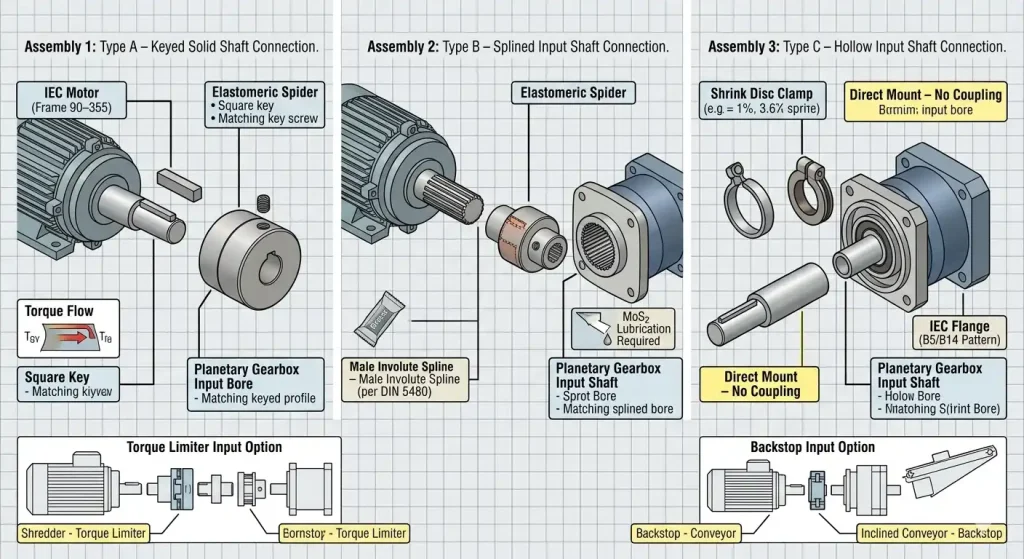
The gearbox input shaft key connection is the most widely used motor-to-gearbox interface in standard industrial applications. The motor shaft has a rectangular keyway machined into it; the coupling hub (or direct coupling) has a matching keyway; a square or rectangular key is inserted to transmit torque through the contact between the key and the keyway walls. The planetary gearbox input shaft bore accepts the motor shaft with the key, and a setscrew or end cap locks the assembly axially.
The key connection has one significant limitation: it transmits torque through a small contact area between the key and the keyway, creating a stress concentration at the keyway corners. At the very high torques encountered in multi-stage planetary gearbox input shafts (which are at the motor’s full rated torque — not the multiplied output torque), this stress concentration can initiate fatigue cracking in the shaft at the keyway if the key fit is not correct. The correct key fit is a transition fit in the shaft keyway (slight interference) and a clearance fit in the hub keyway — this prevents the key from fretting in the shaft while allowing assembly with the hub.
Type B
Splined Input Shaft — For High Torque and Frequent Assembly/Disassembly
The splined input shaft planetary gearbox uses a multi-tooth spline profile on both the motor shaft and the gearbox input bore — typically involute spline per DIN 5480 or ANSI B92.1. The spline distributes torque across all teeth simultaneously, eliminating the stress concentration at keyway corners. Splined connections can transmit 3–5× the torque of a keyed connection of the same shaft diameter, making them the correct choice for high-torque applications (above 500 Nm at the input shaft) and for applications with frequent motor swaps where a quick-disconnect connection is operationally useful.
The critical installation requirement for splined input shafts: lubrication. A dry spline assembly under torque fretting — the microscopic relative motion between spline tooth flanks caused by torque variation — produces fretting corrosion at the spline contact surfaces within 500–1,000 operating hours. Apply a light film of MoS₂ grease (Molykote G-n or equivalent) to the spline teeth at every assembly event. Never assemble a splined connection dry.
Type C
Hollow Input Shaft — Direct Motor Shaft Mounting, No Coupling Required
The hollow input shaft gearbox eliminates the coupling entirely — the motor shaft passes directly into the gearbox hollow input bore and is clamped by a shrink disc (or key) inside the housing. The motor flange bolts directly to the gearbox input flange, creating a compact integrated motor-gearbox assembly with no intermediate coupling components.
This is the standard configuration for IEC motor to planetary gearbox connection in all gearbox families designed for direct motor mounting — including our complete inline and right-angle ranges. The hollow input bore is sized to accept standard IEC motor shaft diameters (from 19 mm for IEC 80 to 75 mm for IEC 355) with tolerances matching the motor shaft tolerance class. The gearbox input flange bolt circle matches the IEC standard motor flange B14 or B5 pattern for the corresponding frame size.
The primary advantage of the hollow input shaft configuration — beyond the elimination of coupling components — is the elimination of coupling alignment errors. Because the motor shaft is directly supported inside the gearbox input bore, the motor shaft and the gearbox input shaft are inherently coaxial. This removes the radial load that coupling misalignment imposes on the gearbox input bearing — one of the most common avoidable failure sources in coupled installations.
Our inline planetary gearbox series is available with hollow input shaft for all IEC motor frame sizes from 80 to 355, covering motor shaft diameters from 19 mm to 75 mm. The input flange bolt pattern matches both B5 (face mount, motor flange bolts through the flange into the gearbox housing) and B14 (face mount, gearbox flange bolts into the motor mounting face) configurations. For the selection between these and other mounting configurations, see our mounting configuration selection guide.
IEC Motor Frame to Gearbox Input — Standard Shaft Diameter Reference
| IEC Frame | Shaft Ø (mm) | Typical Power (kW) | Input Shaft Torque Range |
|---|---|---|---|
| 90 | 24 | 0.75–2.2 | 5–15 Nm |
| 132 | 38 | 5.5–11 | 35–75 Nm |
| 180 | 48 | 15–30 | 100–200 Nm |
| 225 | 60 | 37–55 | 240–360 Nm |
| 280 | 75 | 75–132 | 480–850 Nm |
At 1,500 RPM nominal. Above IEC 280, splined or shrink disc input is recommended over keyed connection.
Motor-to-Gearbox Interface Confirmed Before You Order — IEC Frame, Shaft Ø, and Connection Type.
Motor IEC frame size, rated power, and required output torque and ratio. We confirm the correct hollow bore diameter, flange pattern, and connection type — and return a quotation with dimensional drawing within 24 hours. MOQ 1 unit.
Get a Motor-Matched Gearbox Quote →
📧 [email protected] · Canada Planetary Gear Drive Co., Ltd · ISO 9001:2015
Related Searches
planetary gearbox input shaft · planetary gearbox motor coupling · gearbox input shaft key connection · splined input shaft planetary gearbox · IEC motor to planetary gearbox connection
Torque Limiter and Backstop at the Input Shaft — When to Add These Components
Two optional components are frequently fitted at the gearbox input shaft position in specific applications: a torque limiter and a backstop (also called an anti-reverse device or one-way clutch). Understanding when each is required — and why adding them to applications that do not need them creates its own problems — is part of correct input shaft specification.
A torque limiter is a slip coupling inserted between the motor shaft and the gearbox input — it disengages (slips) when the transmitted torque exceeds a set threshold, protecting both the motor and the gearbox from overload events caused by a machine jam, foreign object ingress, or operator error. Torque limiters are appropriate for applications with frequent jam risk (auger conveyors, wood chippers, shredders) where the overload occurs regularly enough that designing the gearbox to withstand it at SF 3.0+ is not economically viable. They are not appropriate for applications with infrequent but severe overload — such as crane hoist jams — where the torque limiter’s friction characteristics allow high transient torques before slipping, providing no meaningful protection at the jam event’s peak torque.
A backstop at the input shaft prevents the driven machine from reverse-running when the motor is de-energised — critical for inclined conveyors where a loaded belt would run backward under gravity without the backstop. The backstop is a one-way roller ramp or sprag clutch that transmits torque freely in the drive direction but locks instantly against reverse rotation. In planetary gearbox applications, the backstop is most effective when mounted on the input shaft (at the motor) rather than the output shaft — because the input shaft rotates at higher speed, the backstop disengages more smoothly during the transition from powered to freewheeling operation. Mounting the backstop on the output shaft in a high-torque application creates a backstop that must absorb the full output torque at the moment of engagement — potentially damaging the backstop ramps.
Our inline planetary gearbox series is available with input-shaft torque limiter and backstop provisions as optional factory-fitted components across all frame sizes. Specify the required torque limiter slip torque and the backstop rated input torque at the time of order — these components require confirmation of the exact input shaft configuration and cannot be retrofitted after gearbox manufacturing.
editor:WM