
Industry Application · Food & Beverage Processing
Food Industry Planetary Gearbox: The Complete Specification Checklist for Hygienic Drive Systems
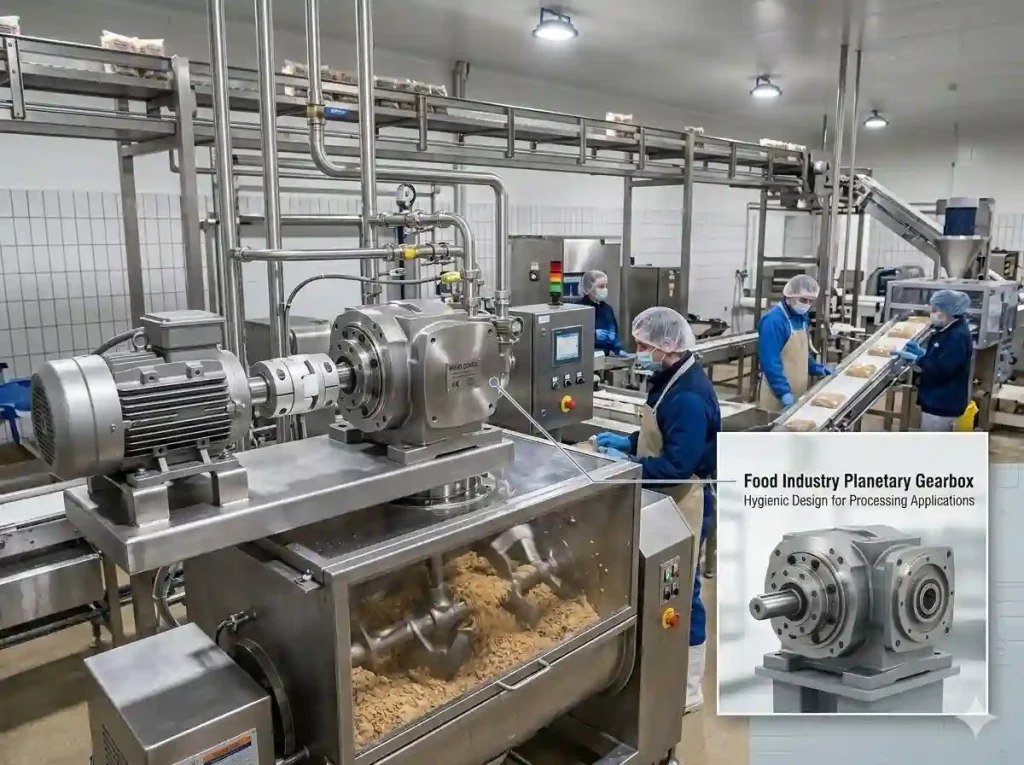
A food industry planetary gearbox is not simply a standard gearbox with a coat of white paint. It is a fundamentally different specification: different housing material, different surface finish, different seal compound, different lubricant chemistry, and a different cleaning protocol compatibility. Every one of these differences is mandated by food safety regulations — not by engineering preference.
Regulatory Framework
In North American food processing facilities, gearboxes in food-contact or splash-zone positions must comply with NSF/ANSI 169 (equipment for use in food processing areas) and the lubricant must be NSF H1 registered (incidental food contact permitted). In Europe, Regulation (EC) No 1935/2004 on materials in contact with food applies. In Australia and New Zealand, FSANZ Standard 3.2.3 governs food premises equipment. A gearbox supplier who cannot provide documentation confirming compliance with the relevant regional standard should not supply food processing facilities.
The 6-Point Specification Checklist — Food Processing Planetary Gearbox
The stainless steel planetary gearbox housing is mandatory in food-contact and washdown zones because cast iron and aluminium alloy housings develop surface pitting and microbial harbouring sites under repeated CIP (Clean-In-Place) or high-pressure washdown cycles. Grade 304 stainless is adequate for low-acid products (dairy, bread, confectionery). Grade 316 is required for high-acid environments (citrus processing, tomato sauce, vinegar, fermentation facilities) where chloride stress corrosion of 304 stainless is a documented failure mode. The housing surface finish must be Ra ≤ 0.8 µm (electropolished) — rough surfaces harbour biofilm that is not removed by standard CIP protocols.
The IP69K planetary gearbox rating is the only standard that tests against high-pressure, high-temperature water jets — the exact conditions of a CIP washdown with 80 bar, 80°C water at close range. IP65 tests at low pressure from any direction. IP67 tests for submersion at 1 metre depth. Neither replicates a food factory CIP washdown. IP69K tests at 80 bar, 80°C water jet applied from 10–15 cm at all angles — this is the standard that a food processing gearbox must meet, without exception.
For the full comparison of IP ratings and their practical differences, see our IP rating selection guide — which covers IP55 through IP69K with the test conditions behind each rating.
The food grade gearbox lubricant in the H1 category is formulated without aromatic hydrocarbons, heavy metals, or compounds restricted under FDA 21 CFR 178.3570. If the gear oil seal fails during operation and a small quantity of gear oil contacts the product, H1 registration means the incidental contamination is within permitted limits and does not require a product recall. Standard GL-5 mineral gear oils are not H1 registered — they contain sulphur-based EP additives that are not permitted in food-contact lubricant formulations. Always verify the H1 registration number with the NSF database before specifying any gear oil for a food processing gearbox.
Standard nitrile (NBR) shaft seals are compatible with mineral gear oil but degrade rapidly in contact with chlorinated CIP solutions (sodium hypochlorite concentration 200–400 ppm) and in high-acid product environments. EPDM seals are chemically resistant to chlorinated cleaners and most organic acids — correct for dairy, citrus, and fermentation applications. PTFE shaft seals (PTFE lip on stainless steel garter spring) provide the broadest chemical compatibility and the lowest friction coefficient, at higher unit cost. PTFE is the preferred specification for any gearbox that will contact cleaning chemicals of unknown or variable composition.
A hygienic planetary gearbox housing has no horizontal ledges, recesses, bolt head pockets, or dead-end cavities on its external surface. Any horizontal surface accumulates product residue, water, and biofilm between cleaning events — this is one of the most common food safety audit failure points on drive systems. Hygienic gearboxes use sloped surfaces, continuous radii at housing corners, and countersunk fasteners flush with the housing surface to eliminate all retention points. The mounting feet, if present, must also be solid (no hollow section that traps water) with drain holes at the lowest point.
Food facility procurement teams and quality managers require a documentation package from the gearbox supplier: the NSF/ANSI 169 or equivalent compliance declaration; the stainless steel material grade certificate (EN 10204 3.1 for Grade 316); the seal compound chemical resistance confirmation; and the gear oil NSF H1 registration certificate with NSF database reference number. Without this documentation, the gearbox cannot be approved by the facility’s food safety management system regardless of its physical specification. Request the documentation package at the time of quotation — not after delivery.
Food Processing Applications Requiring Hygienic Gearboxes
Conveyor belt head drives
Filling machine index drives
Homogeniser and pump drives
Auger and screw conveyor drives
Tumbler and marinating drum drives
Packaging line drives
Cheese vat and curd cutting drives
Fermentation vessel agitator drives
For torque ranges from 500 Nm (small filling machine index drives) to 50,000 Nm (large mixing vessels), our inline planetary gearbox series is available with Grade 316 stainless housing, IP69K sealing, PTFE shaft seals, and NSF H1 gear oil pre-fill across all 16 frame sizes. Full documentation package included with every food-spec order.
CIP Washdown Compatibility — What “Washdown-Safe” Actually Requires
CIP (Clean-In-Place) systems in food processing facilities cycle through several chemical stages: alkaline detergent (1–2% NaOH, 75°C), acid rinse (0.5–1% nitric or phosphoric acid, 65°C), sanitiser (200–400 ppm sodium hypochlorite), and final hot water rinse. Each chemical stage attacks different materials — the alkaline phase attacks aluminium and zinc alloys; the acid phase attacks plain carbon steel and cast iron; the chlorinated sanitiser phase attacks standard nitrile seals and 304 stainless at welded joints. A gearbox that survives one CIP cycle but fails after 50 cycles has not been tested for the combined chemical exposure over the full service life.
The practical test for CIP compatibility in a food processing gearbox is not the IP69K water jet test — that tests pressure and temperature, not chemical resistance. True CIP compatibility requires immersion testing in each of the four CIP chemical phases at the operating concentrations and temperatures for a cumulative exposure time equivalent to at least 2 years of daily cleaning cycles before the product is supplied to a food facility. Request CIP test data, not just an IP69K certificate, when qualifying any gearbox for food processing service.
Food Industry Planetary Gearbox — NSF H1, IP69K, Grade 316 SS. Quoted in 24 Hours.
Tell us the drive application, required torque and ratio, and your facility’s regional food safety standard (NSF/FDA, EU, FSANZ). We specify the correct configuration and return a quotation with full documentation package within 24 hours. MOQ 1 unit.
Get a Food-Grade Gearbox Quote →
📧 [email protected] · Canada Planetary Gear Drive Co., Ltd · ISO 9001:2015
Related Searches
food industry planetary gearbox · hygienic planetary gearbox · stainless steel planetary gearbox · IP69K planetary gearbox · NSF H1 planetary gearbox
Maintenance Intervals — How Food Processing Changes the Schedule
Standard industrial planetary gearbox maintenance intervals (oil change every 2,000 hours, seal inspection every 4,000 hours) are not appropriate for food processing gearboxes. Three factors specific to food environments accelerate seal and lubricant degradation compared to equivalent industrial installations of the same torque class. First, the CIP chemical exposure accumulates seal damage per cleaning event, not per operating hour — a gearbox cleaned 3 times per day for 300 operating days accumulates 900 chemical exposure events per year regardless of how many hours it runs. Second, the H1 NSF-registered lubricants permitted in food processing have inherently lower EP additive concentration than standard GL-5 mineral oils, resulting in faster gear surface fatigue at equivalent loads. Third, the IP69K high-pressure seal faces degrade faster than standard IP65 seals because the seal lip spring force must maintain contact against 80-bar water jets, which fatigues the spring more rapidly than passive IP65 splash protection.
Recommended maintenance intervals for food processing planetary gearboxes: H1 gear oil change every 1,000 operating hours or 6 months, whichever comes first; shaft seal visual inspection every 500 operating hours or 3 months; seal replacement every 2,000 hours or annually regardless of visible condition. These intervals ensure that the NSF H1 lubricant remains within its rated additive life and that the PTFE or EPDM seals are replaced before they enter the end-of-life degradation phase where ingress probability increases rapidly.
Our inline planetary gearbox series in the food-grade specification is available with a pre-completed maintenance schedule document tailored to food processing intervals, suitable for inclusion in the facility’s HACCP or food safety management plan. This document is included at no charge with all food-grade orders and lists every maintenance action with its correct interval in both operating hours and calendar months.