
Planetary Gearbox Basics
Core Keyword: multi stage planetary gearbox · Category: planetary-gearbox-basics
Single-Stage vs Multi-Stage Planetary Gearbox: Choosing the Right Configuration for Your Drive System
Selecting between a single-stage and a multi-stage planetary gearbox is fundamentally a question of required gear ratio. A single planetary stage can achieve reductions of approximately 3:1 to 10:1 within its practical tooth geometry limits. When applications require higher reductions — from 12:1 up to 100:1 or beyond — multiple planetary stages must be connected in series. Understanding the mechanical, economic, and performance implications of adding stages helps engineers make an informed decision that balances gear ratio, efficiency, cost, package size, and noise. This guide walks through each configuration, its trade-offs, and a practical decision framework for industrial servo and motion control applications.
Single-Stage Planetary Gearbox: Capabilities and Limitations
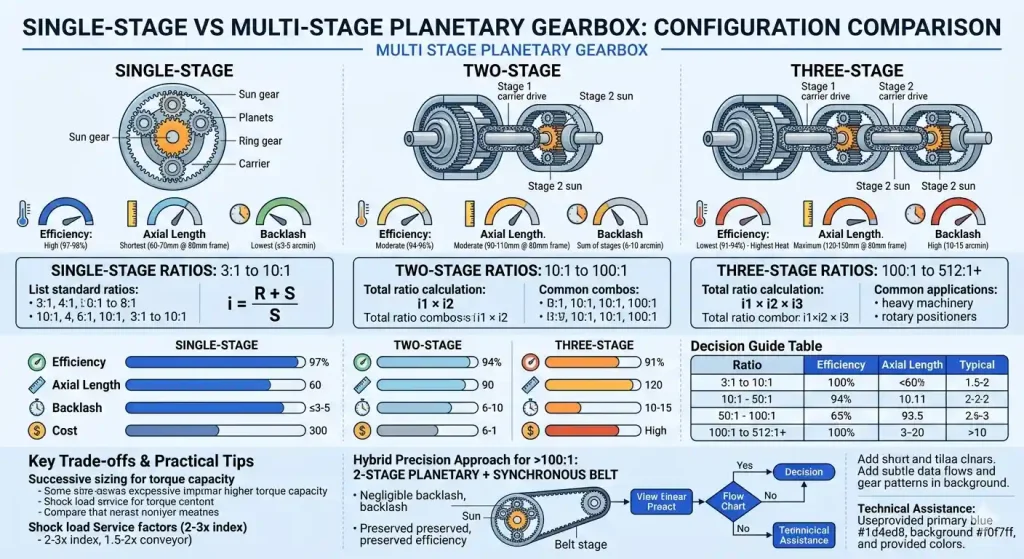
A single-stage planetary gearbox uses one sun gear, one set of planet gears (typically 3 to 5 planets), and one ring gear to produce a speed reduction. The practical ratio range is 3:1 to 10:1, with the most common standard ratios being 3, 4, 5, 6, 7, 8, 9, and 10. The ratio is determined by the relationship between the ring gear teeth count and the sun gear teeth count: i = (R + S)/S, where R is ring gear teeth and S is sun gear teeth.
Advantages of single-stage:
- Highest efficiency — typically 97–98%, with no additional stage losses stacked. This directly translates to lower motor current draw and reduced heat generation in the drivetrain.
- Shortest axial length — important in compact machine designs such as collaborative robot arms, AGV drive wheels, and medical imaging equipment where every millimeter of axis length must be justified.
- Lowest backlash accumulation — only one gear mesh contributes to total backlash. For precision positioning applications requiring ≤3 arcmin, single-stage is the preferred choice.
- Lowest cost — fewer components, simpler manufacturing, and lower assembly time compared to multi-stage units.
- Simplest lubrication management — one oil compartment with a single fill port and breather, reducing maintenance complexity.
Limitations: A single stage cannot achieve ratios above 10:1 within standard planetary gear proportions. Attempting to push beyond this limit results in sun gears with too few teeth to function reliably (leading to undercutting and tooth stress concentration), and planet gears that cannot physically fit in the available space. For ratios above 10:1, a two-stage design is mechanically necessary.
Two-Stage Planetary Gearbox: Higher Ratios with Moderate Efficiency
In a two-stage planetary gearbox, the planet carrier of the first stage drives the sun gear of the second stage. The overall ratio is the product of both stage ratios: i_total = i₁ × i₂. This arrangement extends the achievable ratio range to approximately 10:1–100:1. The first stage typically uses a lower ratio (3:1 to 5:1) to keep the input side torque manageable, while the second stage provides the higher multiplication (5:1 to 10:1).
Standard two-stage ratio combinations available from most precision gearbox manufacturers:
- 16:1 (4×4)
- 20:1 (4×5)
- 25:1 (5×5)
- 28:1 (4×7)
- 35:1 (5×7)
- 40:1 (5×8)
- 50:1 (5×10)
- 64:1 (8×8)
- 70:1 (7×10)
- 100:1 (10×10)
Efficiency trade-off: Two-stage efficiency (94–96%) is lower than single-stage (97–98%) because each stage contributes its own meshing losses and bearing friction. For applications running continuously at full load, the 2–3% efficiency difference translates to measurable energy cost differences over a year of operation. For intermittent duty cycles (less than 20% duty cycle), the efficiency difference is rarely significant enough to drive the stage decision.
Backlash accumulation: Total backlash in a two-stage gearbox is approximately the sum of both stage backlashes. A gearbox with 3 arcmin per stage will have 6 arcmin total — acceptable for most positioning applications but too high for precision indexing. For applications requiring total backlash ≤3 arcmin, a single-stage gearbox or a two-stage gearbox with precision-lapped gear sets (at higher cost) is required.
Our 311 Series Planetary Gearbox is available in two-stage configurations covering ratios from 16:1 through 100:1, with standard motor flanges for direct servo and stepper motor mounting. All units are supplied with synthetic grease lubrication for maintenance-free operation in any mounting orientation.
Three-Stage Planetary Gearbox: Maximum Ratio in a Compact Package
Three-stage planetary gearboxes extend ratios to 100:1–1000:1 and beyond. They are used in applications requiring very high torque multiplication from high-speed motors — such as heavy winding machinery (paper mill reels, wire winding), large rotary positioners (welding positioners, indexing tables), and some wind turbine pitch control designs. The overall ratio is the product of three stage ratios, allowing compact packages to achieve reductions that would otherwise require a separate belt or chain reduction stage.
However, three-stage units carry significant penalties:
- Efficiency loss: 91–94% typical — meaning 6–9% of input power is lost as heat. For a 5 kW motor, this is 300–450 watts of heat that must be dissipated from the gearbox housing.
- Larger axial length: Three stages typically add 80–120% to the base single-stage length, which may exceed machine design envelopes.
- Higher backlash: 9–15 arcmin total for standard precision grades, making three-stage units unsuitable for precision positioning applications.
- Higher cost: Three-stage units are typically 60–100% more expensive than equivalent torque-rated two-stage units from the same product family.
For most industrial servo applications requiring ratios above 100:1, engineers increasingly prefer alternative approaches — such as a two-stage planetary gearbox combined with a secondary belt reduction — rather than a three-stage planetary unit, because the belt stage adds minimal backlash (0.5–1 arcmin typical for synchronous belts) and can be sized for very high ratios at low cost. The belt also adds a mechanical fuse that protects the gearbox from shock loads, and the belt stage can be serviced without removing the gearbox from the machine.
For applications where a three-stage planetary is still the correct choice, our engineering team can provide ratio combinations up to 512:1 in standard housing sizes. Contact us with your required output speed and motor RPM for a stage-by-stage ratio recommendation.
How Adding Stages Affects Torque Capacity and Output Rating
Adding stages does not simply multiply torque proportionally to the ratio increase, because each stage must be sized to carry the torque it transmits. In a well-designed multi-stage gearbox, each successive stage is built larger (larger housing, larger gears, larger bearings) because it carries higher torque than the preceding stage. The gearbox output stage — the final planetary set — determines the maximum output torque rating. The input stage only needs to carry the motor torque multiplied by the first stage ratio, so it can be smaller in some designs.
Engineers should verify that the rated output torque of the selected gearbox (not just the gear ratio × motor torque) is sufficient for the application. A common specification error is calculating required torque as “motor torque × ratio” and then selecting a gearbox with a rated output torque slightly above that number — but failing to account for shock load service factors (typically 2–3× continuous torque for indexing applications, 1.5–2× for conveyor drives). The gearbox is the limiting component in the drivetrain, not the motor. If the gearbox fails in the field, the machine stops; if the motor overloads, the drive faults safely.
For two-stage and three-stage gearboxes, always check the manufacturer’s rated output torque at the output flange — not the input torque. Some low-quality manufacturers quote input torque multiplied by ratio to give an “effective output torque” that is not validated by physical testing. Our gearboxes are 100% torque-tested at the output shaft before shipment, with a test report provided for each unit.
Package Size and Length Comparison — Real Dimensions by Stage Count
Each additional planetary stage adds approximately 30–60% to the total gearbox axial length (depending on gearbox size and ratio). For a typical 80 mm frame size planetary gearbox:
- Single-stage: 60–70 mm axial length
- Two-stage: 90–110 mm axial length
- Three-stage: 120–150 mm axial length
For machine designs where overall axis length is tightly constrained — such as delta robots with limited arm length, multi-axis machining centers with closely spaced spindles, or AGV drive modules — minimizing gearbox length is an active design constraint. When a two-stage gearbox’s axial length exceeds the allowed space, consider these alternatives:
- A right-angle gearbox to redirect the motor axis parallel to the available space, reducing the in-line length at the cost of adding a bevel gear stage.
- A higher-speed motor with a lower gear ratio that fits in a single-stage unit — for example, replacing a 1,500 RPM motor with a 3,000 RPM motor reduces the required ratio by half, possibly moving from two-stage to single-stage.
- A direct-drive torque motor that eliminates the gearbox entirely for low-ratio, high-torque applications (typically up to 500 Nm).
Stage Selection Decision Guide — Practical Engineering Matrix
| Required Ratio | Recommended Configuration | Typical Efficiency | Typical Backlash (arcmin) |
|---|---|---|---|
| 3:1 – 10:1 | Single stage | 97–98% | 3–5 |
| 12:1 – 100:1 | Two stages | 94–96% | 6–10 |
| 100:1 – 512:1 | Three stages | 91–94% | 10–15 |
For ratios above 100:1 where precision is required, consider a two-stage planetary + synchronous belt drive combination. The belt stage adds negligible backlash (0.5–1 arcmin), preserves efficiency (belt efficiency 97–98%), and allows the planetary gearbox to operate at a lower ratio (25:1 to 50:1) where it is more efficient and has lower backlash. This hybrid approach is common in large rotary tables, antenna positioners, and solar tracking drives.
Review our E-Series Planetary Gearbox range for single and two-stage options across our standard inline housing sizes (40 mm through 180 mm frame sizes). For ratio confirmation and sizing assistance, contact our engineering support team with your motor specifications and required output speed.
Related Products You May Need
⚡ Servo & Stepper Motors
High-speed servo motors (2,000–6,000 RPM) pair ideally with multi-stage gearboxes for high torque multiplication. Flange-mounted direct to our gearboxes — no coupling required.
🛑 Electromagnetic Brakes
Spring-applied, 24V DC brakes for motor-shaft mounting. Essential for high-ratio gearboxes on vertical axes or gravity-loaded positioning systems. Holding torque up to 120 Nm.
⛓️ Sprockets & Drive Chains
Secondary chain reduction stages (up to 10:1 per stage) can replace a third planetary stage at lower cost and with lower backlash. Complete sprocket kits available for all output shaft sizes.
📊 Torque Arm Kits
Reaction torque arms for hollow shaft gearbox installations. Rubber-bushed pivots with 500–800 mm arm lengths. Essential for conveyor and agitator drives using two-stage planetary gearboxes.
Find the Right Stage Count for Your Ratio Requirement
Our product range covers single and two-stage configurations in standard ratios from 3:1 through 100:1, with precision grades (≤5 arcmin backlash) and standard grades (≤10 arcmin). Request a technical consultation to confirm the optimal configuration — include your motor speed, required output speed, and duty cycle for a confirmed recommendation.