
Industry Applications
Core Keyword: planetary gearbox for robotics · Category: industry-applications
Planetary Gearboxes in Robotics and Industrial Automation: Selection Criteria, Performance Requirements, and Application Examples
Robotics is arguably the most demanding application environment for any planetary gearbox. Robot joints must deliver high torque from compact packages, position with micron-level repeatability, operate at continuous duty cycles, survive millions of reversal cycles without backlash growth, and often cope with unpredictable impact loads when the robot interacts with its environment. Understanding what separates a planetary gearbox that succeeds in robotics from one that fails requires examining each performance requirement in detail — from backlash and torsional stiffness to thermal management and service life under cyclic loading.
Why Planetary Gearboxes Dominate Robot Joint Drives
Three fundamental characteristics make planetary gearboxes the preferred drive solution for robot joint actuators, particularly in 6-axis industrial robots, SCARA robots, delta robots, and collaborative robots (cobots). These characteristics directly address the unique demands of robotic motion: high acceleration, precise positioning, and continuous operation over multi-year service lives.
- High torque-to-weight ratio: A precision planetary gearbox for robotics typically delivers 100–500 Nm of rated output torque in a package weighing 0.5–5 kg — a torque density that no parallel-shaft, worm, or cycloidal gearbox can match at the same weight. For a 6-axis robot, reducing gearbox weight at the wrist joints directly increases payload capacity and reduces the torque required from upstream joints.
- Coaxial (inline) geometry: Inline planetary gearboxes mount directly to servo motor output flanges, creating a compact motor-gearbox actuator module that fits within robot arm link dimensions. The coaxial design eliminates the offset created by parallel-shaft gearboxes, which would widen the arm and increase the moment arm under load — a critical advantage for slender, high-reach robot arms.
- Low and consistent backlash: Precision and high-precision planetary gearboxes (≤ 3 arcmin, ≤ 1 arcmin) maintain their backlash specification throughout their service life when properly lubricated — a requirement for robots where positioning accuracy must remain stable across tens of millions of operating cycles. Backlash growth is a leading cause of robot recalibration costs in high-volume manufacturing.
Explore our EP-306 Inline Planetary Gearbox, a precision servo gearbox designed for direct mounting to standard servo motors used in robotic joint actuators. Available backlash grades: standard (≤ 8 arcmin), precision (≤ 3 arcmin), and high-precision (≤ 1 arcmin).
Key Performance Requirements for Robot Gearboxes
1. Backlash ≤ 3 arcmin for standard robots; ≤ 1 arcmin for high-precision applications
A 6-axis articulated robot with six joints accumulates backlash through each joint. At the tool center point (TCP), backlash at the wrist joints contributes most to positional error because the wrist joints are furthest from the base and their angular error multiplies at TCP. Standard industrial robots specify ≤ 3 arcmin per joint; high-precision assembly robots (used for electronics assembly, medical device manufacturing) specify ≤ 1 arcmin. For reference, 1 arcmin of backlash at a 500 mm arm length produces 0.145 mm of positional error at the TCP — unacceptable for precision assembly operations requiring ±0.05 mm repeatability.
2. High torsional stiffness
Torsional stiffness determines the robot’s natural frequency. A stiffer drivetrain has a higher natural frequency, allowing the servo controller to use higher control bandwidth and achieve faster settling times. For assembly operations requiring rapid, precise positioning, torsional stiffness is as important as backlash in determining achievable repeatability. A low-stiffness gearbox introduces a “spring” between the motor and the load, causing overshoot and extended settling time — often misdiagnosed as servo tuning problems when the root cause is gearbox deflection.
3. Rated for millions of reversal cycles
A welding robot performing 1,000 welds per day reverses each joint axis multiple times per weld cycle. Over a 10-year service life, the wrist joint gearbox may undergo 20–50 million direction reversals. Planetary gearboxes for robotics must maintain backlash and torque rating specifications throughout this fatigue loading without requiring rebuild. The critical wear components are the planet bearing pins and the gear teeth flanks — both must be case-hardened (58–62 HRC) and precision ground to withstand cyclic loading without pitting or spalling.
4. Low operating temperature rise
Robot arms are sealed enclosures with limited heat dissipation. A gearbox that runs hot increases the ambient temperature inside the arm, affecting servo motor performance (reduced torque at elevated temperatures) and reducing lubricant life. Planetary gearboxes for robotics should be specified for continuous operation with a temperature rise ≤ 40°C above ambient at rated torque.
Collaborative Robot (Cobot) Gearbox Requirements
Collaborative robots — designed to work alongside human operators without safety guarding — impose additional requirements beyond those for traditional industrial robots. Cobots must be inherently safe through force and speed limiting, which affects gearbox selection significantly.
- Backdrivability: Cobots must be physically compliant when a human pushes against them — the drive system must allow the motor to be back-driven without damage when the robot arm is deflected by human contact. Some cobot designs use specific planetary gearbox ratios (≤ 7:1 on outer joints) to maintain backdrivability while still providing useful torque amplification. Higher ratios (≥ 20:1) make the joint non-backdrivable, which is acceptable for base joints but not for wrist or elbow joints in cobot designs.
- Low reflected inertia: Cobot joints must respond quickly to contact detection (typically within 50 ms), requiring low reflected inertia at the motor shaft. Single-stage low-ratio planetary gearboxes (3:1 to 5:1) or direct-drive configurations are used to minimize reflected inertia. Reflected inertia scales with 1/i², so a 5:1 ratio reduces reflected load inertia by 96% compared to direct drive — but also reduces backdrivability proportionally.
- Compact, smooth housings: Cobot design standards require smooth external surfaces without exposed pinch points. Planetary gearboxes with flush, rounded housings and no protruding shaft ends are preferred. All fasteners should be countersunk or covered, and there should be no sharp edges that could injure an operator during incidental contact.
- Force-sensing compatibility: Many cobots integrate torque sensors at the output of the gearbox. The gearbox must be designed with a hollow output shaft or a through-bore to accommodate the sensor wiring and mounting hardware.
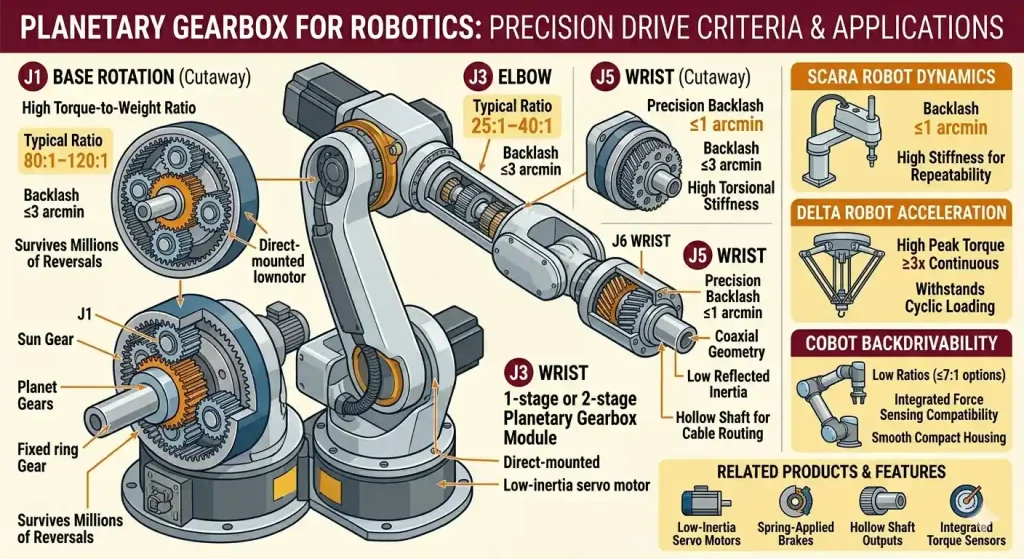
Gearbox Selection by Robot Axis — Practical Sizing Guide
| Axis Position | Typical Torque (Nm) | Typical Ratio | Backlash (arcmin) | Stages |
|---|---|---|---|---|
| Base rotation (J1) — 500kg payload class | 1,500–3,000 | 80:1 – 120:1 | ≤ 3 | 2-stage |
| Base rotation (J1) — 50–100kg class | 300–800 | 50:1 – 80:1 | ≤ 3 | 2-stage |
| Shoulder (J2) — 50kg class | 200–500 | 40:1 – 60:1 | ≤ 3 | 2-stage |
| Elbow (J3) — 10–20kg class | 80–200 | 25:1 – 40:1 | ≤ 3 | 2-stage |
| Wrist (J4–J6) — precision class | 20–80 | 5:1 – 20:1 | ≤ 1 | 1-stage or 2-stage |
| Wrist (J4–J6) — general industrial | 20–80 | 5:1 – 20:1 | ≤ 3 | 1-stage or 2-stage |
SCARA and Delta Robot Gearbox Applications — High-Speed Dynamics
SCARA robots (Selective Compliance Articulated Robot Arm) are used extensively in electronic component assembly and high-speed pick-and-place operations. The horizontal arm joints require high torsional stiffness and low backlash to maintain ±0.01 mm repeatability at cycle rates of 60–120 picks per minute. Single-stage and two-stage precision planetary gearboxes with helical gearing are the standard selection for SCARA joint actuators. The selective compliance characteristic — rigid in the vertical axis but compliant in the horizontal plane — is achieved through the bearing arrangement, not the gearbox. The gearbox must still provide high stiffness in both axes.
Delta robots — used in food packaging, pharmaceutical blister packing, and electronics assembly — operate at very high cycle rates (up to 200+ picks per minute). The three-arm actuators require gearboxes with extremely high peak-to-continuous torque ratios (typically 3:1 to 5:1), because the acceleration torque demand during rapid point-to-point motion far exceeds the steady-state holding torque. At 200 picks per minute, each pick involves a full acceleration-deceleration cycle in 0.3 seconds — the gearbox must withstand repeated high acceleration torque peaks without fatigue failure. Our inline planetary gearbox range includes models with peak torque ratings of 3× continuous, suitable for high-cycle delta robot applications.
Key difference between SCARA and delta robot gearbox requirements: SCARA robots require higher accuracy (lower backlash) because they perform insertion and assembly operations; delta robots require higher peak torque capacity because they perform high-speed pick-and-place with minimal dwell time. The gearbox selection reflects this difference — SCARA applications prioritize backlash (≤ 1 arcmin), delta applications prioritize peak torque rating (≥ 3× continuous).
Related Products You May Need
⚡ Low-Inertia Servo Motors
Low-inertia servo motors paired with precision planetary gearboxes for high-speed robot joint actuators. Matching IEC flanges for direct mounting.
🛑 Spring-Applied Brakes
24V DC motor-shaft brakes for vertical robot axes — hold position safely during e-stop or power loss events. Zero-backlash brake designs available for precision axes.
⛓️ Hollow Shaft Outputs
Hollow output shaft planetary gearboxes for through-bore cable routing — essential for wrist joints where power and signal cables must pass through the axis center.
📊 Torque Sensors
Integrated torque sensors for force-controlled robotics and cobot applications. Mounts between gearbox output and robot arm structure.
Specify a Planetary Gearbox for Your Robot or Automation System
Our precision planetary gearboxes are available in backlash grades from ≤ 3 arcmin to ≤ 1 arcmin with IEC/NEMA motor flanges for direct servo mounting. We provide full sizing support — including torque verification, stiffness calculation, and lifetime cycle analysis — for robot joint applications.