
Planetary Gearbox Basics
Core Keyword: planetary gearbox gear ratio · Category: planetary-gearbox-basics
How to Calculate Planetary Gearbox Gear Ratio: Formulas, Examples, and Practical Selection
The planetary gearbox gear ratio is arguably the single most important specification in gearbox selection. It determines output speed, output torque, inertia reflected back to the motor, and ultimately whether your servo system can achieve the required acceleration and positioning performance. This guide explains the calculation formulas, works through real-world examples, and addresses the practical considerations engineers encounter when selecting gear ratios for precision motion control applications.
The Basic Gear Ratio Formula for a Single Planetary Stage
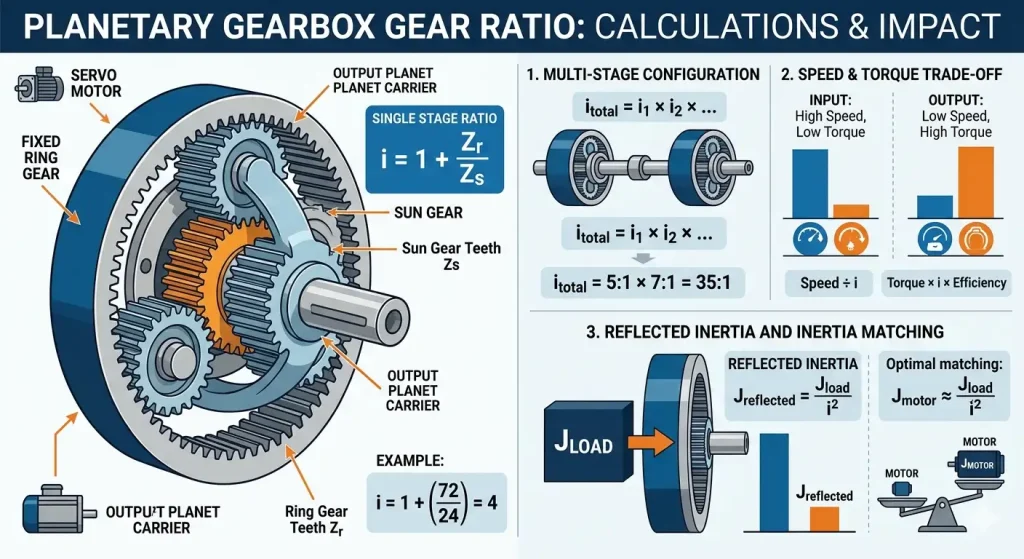
For a standard planetary arrangement — where the ring gear is fixed, the sun gear is the input, and the planet carrier is the output — the gear reduction ratio is:
i = 1 + (Zr ÷ Zs)
Where: i = gear ratio, Zr = number of ring gear teeth, Zs = number of sun gear teeth
Example: A planetary stage with a 72-tooth ring gear and a 24-tooth sun gear: i = 1 + (72 ÷ 24) = 1 + 3 = 4. The output shaft rotates once for every 4 rotations of the input shaft — a 4:1 reduction.
The relationship between sun and ring gear teeth is constrained by the requirement that planet gears mesh correctly with both. The general constraint is: Zr = Zs + 2 × Zp, where Zp is the number of planet gear teeth. This geometric constraint limits single-stage planetary gear ratios to a practical range of approximately 3:1 to 10:1.
Why Single-Stage Ratios Are Limited to 3:1 – 10:1
The practical lower limit of approximately 3:1 comes from the requirement that planet gears fit physically between the sun gear and ring gear without overlapping each other. With very few sun gear teeth, the planet gears become disproportionately large and cannot be fitted in sets of three. The upper limit of approximately 10:1 comes from the opposite constraint: to achieve higher ratios, the sun gear becomes so small relative to the ring gear that it has too few teeth to transmit torque without excessive stress on each tooth.
This is why two-stage and three-stage configurations are used when ratios above 10:1 are required.
Multi-Stage Gear Ratio Calculation
In a two-stage planetary gearbox, the output of the first planetary stage drives the sun gear of the second planetary stage. The overall gear ratio is the product of the individual stage ratios:
Example: Stage 1 = 5:1, Stage 2 = 5:1 → itotal = 25:1. The output shaft rotates once for every 25 input shaft rotations.
Example: Stage 1 = 4:1, Stage 2 = 7:1 → itotal = 28:1.
For three-stage gearboxes, the same multiplication applies: itotal = i1 × i2 × i3. Three stages commonly achieve ratios up to 100:1 or beyond, depending on individual stage ratios.
Our 311 Series Planetary Gearbox covers a wide ratio range through configurable single and two-stage setups — ideal for applications that need specific reduction values between 4:1 and 64:1.
Standard Gear Ratio Series: What Manufacturers Offer
Planetary gearbox manufacturers do not produce every possible ratio. Instead, they offer a series of standard ratios derived from their standard planetary gear designs. Typical single-stage ratios available from precision gearbox suppliers include: 3, 4, 5, 6, 7, 8, 9, 10. Two-stage ratios are formed by combining these: 16 (4×4), 20 (4×5), 25 (5×5), 35 (5×7), 40 (5×8), 50 (5×10), 64 (8×8), 70 (7×10), 100 (10×10).
When your required ratio does not match a standard value, the engineering approach is to select the nearest standard ratio and adjust motor speed (via drive programming) to compensate. Alternatively, a combined planetary plus timing belt reduction can achieve non-standard ratios without custom gearing.
How Gear Ratio Affects Output Torque and Speed
The gear ratio directly determines the trade-off between speed and torque. The relationships are:
Output Torque = Input Torque × Gear Ratio × Efficiency
Example: A servo motor producing 5 Nm at 3,000 RPM drives a 5:1 gearbox with 97% efficiency:
Output speed = 3,000 ÷ 5 = 600 RPM
Output torque = 5 × 5 × 0.97 = 24.25 Nm
Note that the rated output torque of a gearbox is a separate specification from what the motor delivers — the gearbox itself has a maximum rated torque that must not be exceeded regardless of what the motor can produce.
Gear Ratio and Reflected Inertia: The Critical Relationship for Servo Systems
For servo motion control applications, gear ratio affects system performance beyond just speed and torque. The gear ratio also changes the inertia that the servo motor “sees” from the load. The reflected inertia formula is:
A 5:1 gearbox reduces reflected load inertia by a factor of 25 (5²). This is extraordinarily important in high-acceleration servo applications where load inertia is large compared to motor inertia. A gear ratio that provides inertia matching (motor inertia ≈ reflected load inertia) will typically yield the best servo bandwidth and settling time.
The optimal gear ratio for inertia matching can be calculated as: ioptimal = √(Jload ÷ Jmotor). If the result doesn’t correspond to a standard ratio, round to the nearest available value.
Selecting Ratio for Continuous vs Peak Torque Requirements
The required output torque should be evaluated against two specifications: rated (continuous) output torque and peak (acceleration) output torque. Most planetary gearboxes are rated for a peak torque of 2–3× their continuous rating for short durations. When sizing, ensure both continuous thermal capacity and peak mechanical load are within the gearbox’s rated limits. Applying a service factor of 1.5–2.0 to continuous load torque is standard practice to account for shock loading in real applications.
The E-Series Planetary Gearbox provides detailed rated and peak torque data across all standard ratios, simplifying the torque verification process during gearbox selection.
Related Products You May Need
Servo & Stepper Motors
Match motor inertia and rated torque with your calculated gearbox input requirements.
Electromagnetic Brakes
Add holding torque for vertical axes where back-driving under gravity must be prevented.
Sprockets & Drive Chains
Add a secondary reduction stage via chain drive when standard gearbox ratios don’t match exactly.
Ready to Select the Right Gear Ratio?
Use our product catalog to match gear ratios, torque ratings, and motor flanges to your specific application. Our team is available for technical assistance.