
Maintenance & Technical
Core Keyword: planetary gearbox failure diagnosis · Category: maintenance-technical
How to Diagnose Planetary Gearbox Failures: Noise, Vibration, Wear Signs, and Root Cause Analysis
Most planetary gearbox failures don’t happen without warning — they develop progressively, and the gearbox communicates its deteriorating condition through noise, vibration, temperature, and oil condition changes for weeks or months before catastrophic failure. The challenge is recognizing these signals early enough to act before an unplanned breakdown. Downtime from a failed gearbox in a continuous process (conveyor, wind turbine, packaging line) can cost $10,000–$50,000 per hour, making early diagnosis a critical economic priority. This guide covers the systematic approach to planetary gearbox failure diagnosis: what to listen for, what to measure, how to interpret oil analysis results, and how to determine root cause so the replacement unit doesn’t fail for the same reason.
The Four Primary Warning Channels — A Diagnostic Matrix
Gearbox deterioration manifests through four diagnostic channels, each providing different information about the failure mechanism. Using all four channels together provides the most accurate diagnosis:
- Noise (audible and ultrasonic): The frequency, character, and load-dependency of abnormal noise indicates which component is failing and what the failure mechanism is. Experienced technicians can often identify the failing component within 10% accuracy using only noise, but vibration analysis provides confirmation.
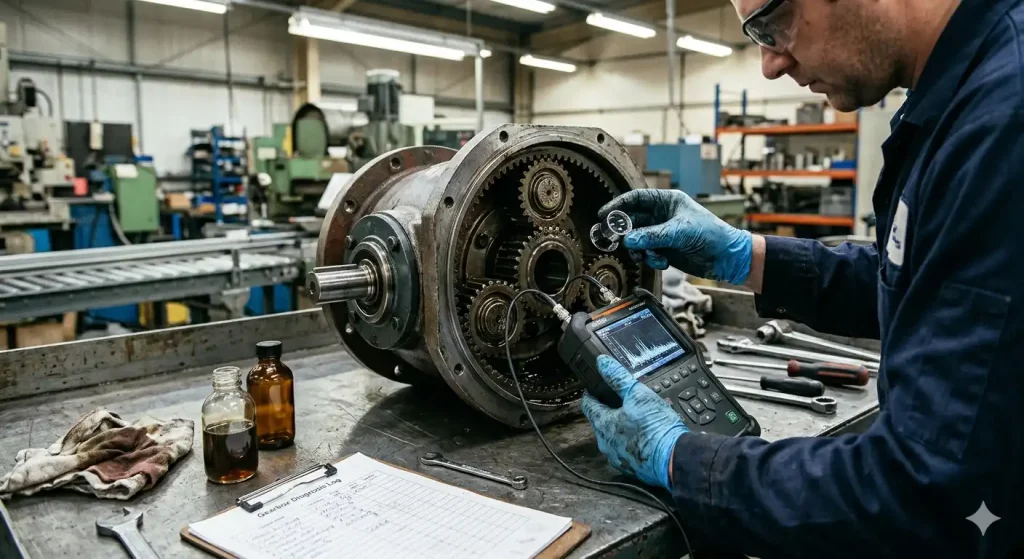
- Vibration (accelerometer data): Accelerometer data reveals the frequency spectrum of mechanical disturbances. Gear mesh frequencies and bearing fault frequencies can be calculated from known gear geometry and bearing dimensions, allowing specific faults to be identified from vibration spectra. Vibration analysis can detect faults 2–3 months before they become audible.
- Temperature (thermography and contact measurement): Elevated gearbox housing temperature above the normal operating value indicates either increased friction (worn or misaligned components), inadequate lubrication, or an overload condition. A 15°C rise above baseline at constant load is a reliable indicator of developing failure.
- Oil condition (visual and laboratory analysis): The appearance, viscosity, particle content, and additive depletion state of the gear oil reflects the internal condition of the gearbox in a way that external inspection cannot. Oil analysis can detect wear 6–12 months before failure in many cases.
Noise Diagnosis: What Different Sounds Mean — Detailed Reference
| Sound Description | Most Likely Cause | Confirmation Method | Action |
|---|---|---|---|
| High-pitched whine at constant frequency, proportional to input speed | Gear mesh resonance (normal at certain speeds) or tooth profile error | Compare to commissioning baseline vibration spectrum | If new, investigate gear accuracy; if present since new, likely normal |
| Rattling or knocking at low speed / direction reversals | Backlash increase — worn gear flanks or loose planet pin bearings | Measure backlash with dial indicator; inspect planet pin fit | Plan replacement; backlash exceeding 2× original spec requires replacement |
| Regular clicking at frequency proportional to output shaft rotation | One planet gear with a damaged or worn tooth | Stethoscope to locate which planet position; vibration FFT will show sidebands | Inspect planet gears; replace if pitting, spalling, or tooth fracture found |
| Rumbling or growling, present at all speeds, increases with load | Bearing spalling (inner or outer race fatigue) | Vibration FFT — look for bearing fault frequencies (BPFO, BPFI, BSF) | Plan for bearing replacement; can run 100–500 hours with spalling but risk of seizure |
| Squealing or screeching under load | Lubrication breakdown — metal-to-metal contact | Check oil level and condition immediately; measure housing temperature | Stop immediately; do not restart without investigation — catastrophic failure imminent |
| Impact noise on startup from cold | High-viscosity oil at low temperature; oil not reaching bearing surfaces | Measure ambient temperature; check oil pour point specification | Upgrade to synthetic oil with better low-temperature fluidity; add oil heater if persistent |
Vibration Analysis for Gearbox Fault Detection — Technical Approach
Vibration signatures in a planetary gearbox are more complex than in simple gear pairs because the planet gears are themselves rotating (the planet carrier rotates, causing the planet gear axes to move in a circular path). The key frequencies to monitor are:
- Gear mesh frequency (GMF): f_mesh = n_input (RPM) × Z_sun / 60. Elevated harmonics (2×, 3× GMF) in the vibration spectrum indicate tooth wear, profile error, or pitch error. Compare to the commissioning baseline spectrum — a 10 dB increase in the first harmonic is a reliable alarm threshold.
- Planet pass frequency (modulation sidebands): f_planet = N_planets × f_carrier. Sidebands around the gear mesh frequency modulated at planet pass frequency (i.e., GMF ± f_planet, GMF ± 2f_planet) indicate uneven load sharing between planets — often caused by one worn or misaligned planet pin. A 6 dB difference between sideband amplitudes is diagnostic of imbalance.
- Bearing fault frequencies (BPFO, BPFI, BSF): These depend on bearing geometry (number of rolling elements, ball diameter, pitch diameter, contact angle) and shaft speed. A bearing database software tool can calculate expected fault frequencies from the bearing part number and measured speed, allowing specific bearing damage to be identified from the vibration spectrum. BPFO (ball pass frequency outer race) appears at approximately 0.4× shaft speed × number of balls; BPFI (inner race) appears at approximately 0.6× shaft speed × number of balls.
- Carrier rotation frequency (sidebands on GMF): f_carrier = f_input / i_stage. Sidebands at GMF ± f_carrier indicate planet carrier imbalance or eccentricity.
A portable vibration analyzer with FFT (Fast Fourier Transform) capability and at least 1,600 lines of resolution is the minimum equipment needed for systematic gearbox condition monitoring. Establish a vibration baseline at commissioning (after 100 hours of run-in) and compare monthly readings against this baseline. A 3× increase in overall velocity amplitude (mm/s RMS) or a 10 dB increase in any frequency component is a reliable threshold for scheduling inspection. For critical gearboxes, permanent online vibration sensors with continuous trending provide the earliest warning.
Oil Analysis: The Most Comprehensive Diagnostic Tool — Interpretation Guide
Regular oil sampling and laboratory analysis provides information that no external inspection can match. A complete oil analysis (ASTM-based test methods) includes:
- Particle count and size distribution (ISO 4406): A cleanliness rating expressed as XX/YY/ZZ (e.g., 21/19/16). A sudden increase in the 4–6 µm or 14–21 µm particle count indicates accelerating wear. The size distribution can indicate whether particles are from gear flanks (large platelets, 20–100 µm) or bearing surfaces (spherical particles from fatigue, 5–15 µm). An ISO 4406 code increasing by 2 points in any range is a significant trend.
- Elemental analysis by ICP-AES (ASTM D5185): Measures concentrations (ppm) of iron (gear/bearing wear — normal < 50 ppm, severe > 200 ppm), copper (bronze bushings or thrust washers — normal < 10 ppm, severe > 50 ppm), chromium and molybdenum (alloy steel gear wear), silicon (external dirt contamination — normal < 15 ppm), and sodium (water contamination from coolant — any detectable sodium requires investigation). Compare against trend data — a sudden rise in any element indicates the onset of accelerated wear.
- Viscosity measurement at 40°C (ASTM D445): Oil that has thinned below its rated viscosity (change > -10% from new oil) due to thermal degradation or fuel/solvent dilution cannot maintain adequate film thickness. Oil that has thickened (change > +15% from new oil) due to oxidation/polymerization increases churning losses and may not flow to bearing surfaces adequately at low temperatures.
- Total Acid Number (TAN) — ASTM D664: A measure of oil acidity from oxidation and additive depletion. New oil TAN is typically 0.3–0.8 mg KOH/g. TAN rising above 2.0 mg KOH/g indicates the additive package is depleted and corrosive acids are forming. Oil with TAN > 2.5 should be changed immediately regardless of hours.
- Water content by Karl Fischer (ASTM D6304): New oil < 200 ppm water. Water > 500 ppm reduces load-carrying capacity and promotes rust. Water > 1,000 ppm (0.1%) is severe — oil should be changed and water source identified.
For our E-Series Planetary Gearbox and 311 Series Planetary Gearbox, oil sampling every 2,000 hours (or every 6 months, whichever comes first) is recommended in high-load or elevated-temperature applications. For critical continuous-duty gearboxes, monthly oil sampling is justified.
Physical Inspection Checklist — When the Gearbox Is Removed
When a gearbox is removed for inspection (either after diagnosis of a developing fault or after a failure), document the following before any disassembly to preserve forensic evidence:
- External appearance (photograph all sides): Oil leaks from shaft seals or housing joints (indicates seal failure or housing warp); corrosion on housing (suggests water ingress or chemical attack); physical damage to housing (indicates impact loading).
- Output shaft backlash measurement before disassembly: Measure and record backlash at multiple positions around the output shaft with the input locked using a dial indicator on a gear tooth. Compare to specification (new gearbox spec is typically 3–8 arcmin). Backlash exceeding 2× the original specification indicates significant gear tooth wear or planet bearing wear.
- Bearing radial play measurement: Measure by deflecting the input shaft with a dial indicator (apply known force if possible). Radial play exceeding 0.05 mm on the input shaft of a gearbox with shaft diameter 20–30 mm indicates input bearing wear. For larger shafts, refer to manufacturer’s allowable play values.
- Gear tooth surface inspection under magnification (10×–20×): After disassembly, inspect sun gear, planet gear (all planets), and ring gear tooth flanks for: pitting (small craters from contact fatigue — < 0.2 mm acceptable, > 0.5 mm severe), spalling (larger material removal — any spalling requires replacement), micropitting (grey frosted appearance on tooth flank — indicates marginal lubrication), scuffing (adhesive wear, directional scratches in the sliding direction — indicates lubrication failure), and plastic deformation (tooth flank compression at tips — indicates overload).
- Bearing inspection (remove bearings from shaft and examine): Inspect raceways for spalling (flaking), pitting, and brinelling (static indentation marks from shock loading or mishandling — appears as regularly spaced indentations on the raceway). Inspect rolling elements for flat spots, pitting, corrosion, and overheating (blue/black discoloration). Smell the cage material — overheated bearings have a distinctive burnt smell even when visually intact. Measure bearing internal clearance; clearance exceeding 2× new specification indicates wear.
Root Cause Analysis: Why Did It Fail? — Failure Mode and Effects Analysis (FMEA) Approach
The most common root causes of planetary gearbox failures, and the forensic evidence that identifies each. Identifying the root cause is essential to prevent repeat failure in the replacement gearbox:
- Lubrication failure (35–40% of failures): Evidence — scuffing and adhesive wear on gear flanks (directional scratches), overheated bearings (blue/black discoloration), darkened or sludged oil (oxidation), additive depletion (high TAN). Root cause: oil level too low, wrong viscosity (too thin for load/temperature), oil change interval exceeded, cooling system failed (fan blocked, radiator clogged).
- Overloading (20–25% of failures): Evidence — tooth breakage (not surface pitting but through-fracture, clean brittle fracture surface), deformed planet carrier (visible bending or twisting), bearing inner ring cracking (circumferential or axial cracks). Root cause: application loads exceeded gearbox rated torque or peak torque rating — often caused by jam events in conveyors, shock loads in crushers, or stall conditions in wind turbines.
- Water ingress (15–20% of failures): Evidence — rust on internal surfaces (orange/brown deposits), emulsified oil (milky appearance), bearing corrosion pitting (etching on raceways and rolling elements). Root cause: seal failure (worn lip, damaged lip, incorrect seal material for chemical environment), condensation in outdoor/wet environment (temperature cycling), high-pressure washdown exceeding seal design pressure rating (common in food industry).
- Misalignment (10–15% of failures): Evidence — non-uniform tooth contact patterns across face width (contact pattern shifted to one side), accelerated wear on one side of teeth (more material removed on one flank), overloaded bearings on one shaft end (spalling localized to one side of bearing). Root cause: motor to gearbox misalignment (angular or parallel misalignment > 0.1 mm for small frames), housing distortion from improper mounting (bolting gearbox to non-flat surface), or shaft deflection under load exceeding coupling capacity.
- Fatigue (5–10% of failures): Evidence — pitting and spalling at end-of-design-life, distributed across all components rather than localized. Root cause: normal end-of-life fatigue after exceeding design life (10,000–20,000 hours typical for precision gearboxes, 20,000–50,000 hours for industrial gearboxes).
Related Products You May Need
⚙️ Replacement Gearbox Units
Direct-fit replacement planetary gearboxes for failed units. Match ratio, torque rating, and mounting dimensions.
🛡️ Upgrade Brakes
If root cause was uncontrolled back-driving, add a fail-safe electromagnetic brake to prevent recurrence on the replacement unit.
📊 Vibration Monitoring Systems
Permanent online vibration sensors with cloud-based trending for early warning of developing faults. 4–20 mA output for integration with plant DCS.
🔧 Oil Sampling Kits
Pre-sterilized oil sampling bottles, vacuum pump, and laboratory analysis services (particle count, elemental analysis, viscosity, TAN, water content).
Need a Replacement Planetary Gearbox After a Failure?
Share your failed unit’s specifications, failure mode, and root cause findings with us. We can recommend a direct-fit replacement or an upgraded specification (higher torque rating, better seals, synthetic lubricant) that addresses the root cause to prevent repeat failure. Forensic analysis of failed units is available for major failures.
editor:WM