
Agricultural & Biomass Application
Pellet Mill Planetary Gearbox: Selecting the Main Drive Reducer for Feed, Biomass, and Wood Pellet Applications
The pellet mill planetary gearbox is the highest-cost single drivetrain component in a pellet production line — and the one most directly responsible for throughput capacity and energy efficiency. Correct specification delivers 8,000–12,000 hours of service life. Incorrect specification delivers 1,500–3,000 hours with accelerating maintenance cost.
Continuous Duty
High Dust Environment
IP55 Minimum
The Pellet Mill Drive System — Where the Gearbox Fits
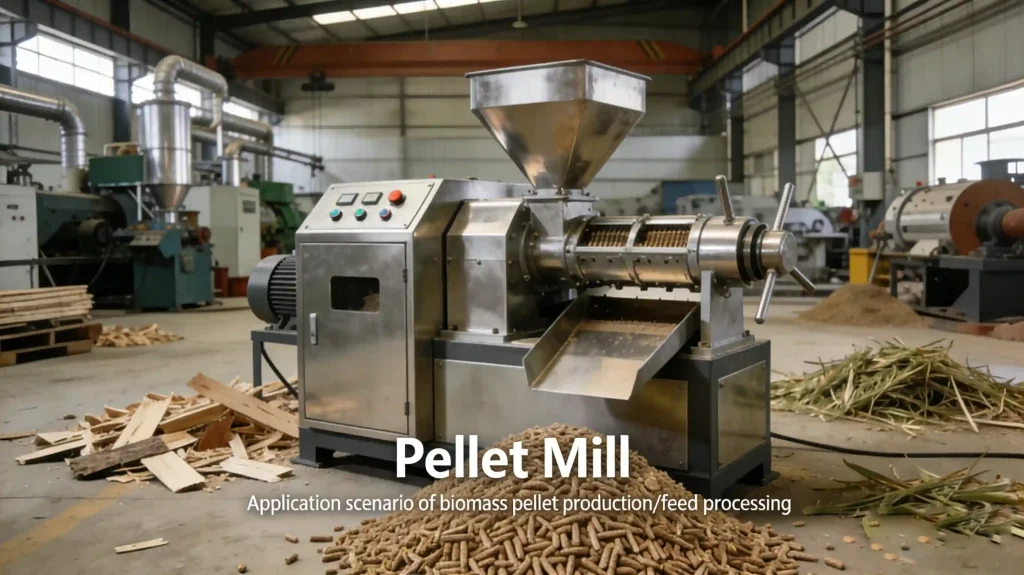
A pellet mill — whether a ring-die animal feed pellet press (CPM, Andritz, Bühler, Pellet Pro) or a flat-die biomass pellet mill — converts raw material (ground grain, sawdust, wood fibre, grass) into uniform cylindrical pellets by forcing the material through a perforated die at high pressure. The driving force comes from the main shaft, which carries either the rotating die (ring-die mills) or the rotating roller assembly (flat-die mills). In both designs, the pellet mill main shaft gearbox connects the electric motor to the main shaft, stepping down motor speed (typically 970–1,450 RPM) to the die or roller speed (60–300 RPM) while multiplying torque by the reduction ratio.
970–1,450 RPM
Gearbox
Ratio 5:1–20:1
100–300 RPM
Pellet output
The gearbox in this drivetrain operates continuously for the full production shift — typically 16–22 hours per day in commercial feed pellet plants — and must handle both steady-state torque during normal pelleting and shock torque events during material blockage (die plugging), which is the most common operational upset in pellet mill operation. Die plugging occurs when feedstock moisture exceeds specification or when a foreign object enters the die, and the resulting torque spike can reach 3–4× the steady-state operating torque within milliseconds.
How Feed Material Affects Gearbox Specification
The material being pelleted directly determines the gearbox torque requirement and service factor. Different materials have dramatically different die resistance characteristics:
Ground corn, soybean meal, wheat middlings — moderate die resistance, consistent torque. Service factor 1.5 adequate. Lower end of pellet mill gearbox torque ratings.
Higher fibre content, variable moisture — more die resistance and more frequent plugging events than grain feed. Service factor 2.0. Biomass content increases unpredictability.
Sawdust, wood shavings, agricultural residue — highest die resistance of all commercial pellet materials. Frequent plugging events. Service factor 2.5–3.0 required.
The Dust Problem — Why Standard Industrial Sealing Is Not Enough
Pellet mills operate in environments with very high airborne dust concentrations — fine particle organic matter from the feed material. This dust is combustible in most feed and biomass applications (creating both an explosion hazard and a gearbox contamination hazard), and it is attracted to the warm surfaces of the gearbox housing via electrostatic and thermal deposition. Over a 500-hour operating period, a standard gearbox housing in a feed mill environment accumulates a compressed dust layer on the housing and shaft seal areas that acts as a moisture-retaining insulating blanket.
This dust layer prevents heat dissipation (raising housing temperature and accelerating oil degradation), retains moisture (accelerating seal corrosion), and packs around the shaft seal lip (abrading the seal contact surface over time). The practical countermeasure is a housing design with minimal horizontal surface area where dust can accumulate, combined with a compressed-air purge fitting at the shaft seal positions to allow periodic seal-area cleaning without full housing disassembly.
Additionally, pellet mill gearboxes in biomass applications where wood dust is present must comply with ATEX Zone 22 (dust explosion zone) requirements in European installations, and equivalent standards under NFPA 61 and NFPA 664 in North American installations. The gearbox housing surface temperature must not exceed 2/3 of the dust cloud ignition temperature — typically requiring that the housing surface remain below 230°C, which is achievable with standard gearbox designs but must be verified at the maximum rated load condition.
Our S series industrial planetary gearbox covers the 34,000–500,000 Nm torque range for large commercial pellet press applications. For smaller pellet mills below 34,000 Nm — common in farm-scale and small commercial installations — our full planetary gearbox range provides the correct frame size with the same service factor and sealing options.
CPM and Andritz Pellet Mill Gearbox Replacement — Aftermarket vs. OEM
The two dominant pellet press brands in the North American and European commercial feed market — CPM (California Pellet Mill) and Andritz — both use proprietary gearbox designs that are supplied exclusively through the OEM service parts channel at premium pricing. The CPM pellet mill gearbox aftermarket has historically been limited because the CPM main gearbox uses a custom housing profile that is not easily replicated by generic industrial gearbox suppliers.
However, for feed plants operating CPM 7900 or CPM 8000 series pellet mills, an engineering alternative is available: replacing the complete gearbox assembly rather than overhauling the OEM unit. This approach uses a dimensionally equivalent high-torque planetary gearbox with matched shaft, flange, and housing dimensions — achieving the same mechanical interface without the OEM parts premium. The key dimensional parameters that must match are the main shaft bore (typically 120–180 mm in commercial CPM mills), the motor flange bolt pattern, and the structural mounting hole positions on the mill frame. Provide the CPM model number and gearbox part number for a dimensional comparison and quotation.
Pellet Mill Planetary Gearbox — Feed, Biomass, and Wood Pellet Applications Quoted in 24 Hours
Provide feed material type, motor kW, die speed (RPM), and existing gearbox part number or dimensions. We size the correct frame with the appropriate service factor and return a formal quotation within 24 hours. MOQ 1 unit.
Get a Pellet Mill Gearbox Quote →
📧 [email protected] · Canada Planetary Gear Drive Co., Ltd · ISO 9001:2015
Related Searches
pellet mill planetary gearbox · feed pellet press gearbox · biomass pellet mill drive gearbox · pellet mill main shaft gearbox · CPM pellet mill gearbox aftermarket
Pellet Mill Gearbox Oil Specification and Change Intervals
The pellet mill gearbox gear oil specification is critical because of three factors that distinguish pellet mill operation from standard industrial applications: the high ambient dust (which blocks the housing breather and raises housing temperature); the constant vibration from the die-roller interaction (which shakes oil away from bearing contact zones faster than in smooth-duty applications); and the frequent torque peaks from die plugging events (which generate momentary oil film collapse at the gear mesh).
Standard SAE 80W-90 GL-5 mineral gear oil is the minimum acceptable specification. For pellet mills operating above 150 kW motor power and at ambient temperatures above 30°C — which covers most commercial feed and biomass plants in Australia, the US South, and Southern Europe — synthetic 75W-140 GL-5 is strongly recommended. The higher viscosity grade maintains adequate gear mesh film thickness during the temperature peaks that occur during sustained maximum-load die pressing, and the synthetic base oil resists oxidation from the elevated temperature more effectively than mineral oil of equivalent grade. The result is a longer oil change interval — 1,500 hours on synthetic 75W-140 vs. 750 hours on mineral 80W-90 — that reduces maintenance shutdowns during peak production periods.
The housing breather on a pellet mill gearbox must be inspected every 250 hours without exception. Feed and biomass dust blocks the breather filter faster than in any other industrial gearbox application. A blocked breather prevents the normal thermal pressure-equalisation that keeps gear oil inside the housing, causing oil expulsion through the shaft seals — the resulting apparent seal failure is in virtually every case a blocked-breather problem, not a seal quality issue. Replace the breather filter element at every 500-hour oil change at minimum. For our full gear oil maintenance guidance across all application types, see the full planetary gearbox range documentation page.
Farm-Scale vs. Commercial Pellet Mill — How Gearbox Selection Differs
The pellet mill market spans a wide range from farm-scale units producing 200–500 kg per hour of hay or grain pellets for on-site livestock feeding, to commercial feed plants producing 20–60 tonnes per hour for bagged retail sale. The gearbox specification differs significantly across this range, not just in torque but in duty cycle, environment, and maintenance access.
Farm-scale flat-die pellet mills — the most common design for on-farm hay pelleting and small poultry or rabbit feed production — typically use right-angle worm gear reducers or compact 2-stage planetary reducers below 5,000 Nm output. The operating environment on a farm-scale machine is often semi-sheltered or fully outdoor, meaning the gearbox is exposed to temperature extremes, rain splash, and UV degradation of seals over a 10–15 year service life. For farm-scale applications, IP65 or better is non-negotiable, and synthetic lubricant is strongly recommended for the wider temperature operating range it provides across seasonal extremes.
Commercial-scale ring-die pellet mills — CPM, Andritz, Bühler, La Meccanica — operate in dedicated mill rooms with controlled temperature and regular maintenance access. The gearbox here is a precision high-torque unit that will be serviced by trained maintenance personnel on a scheduled basis. The priority at this scale is torque capacity and service factor over the pelleting material, with secondary emphasis on oil change access (a commercial pellet mill gearbox may hold 20–60 litres of gear oil, and the drain and fill points must be accessible without removing the gearbox from the machine).
For farm-scale pellet mill gearboxes below 10,000 Nm, our full planetary gearbox range covers right-angle and inline configurations with IP65 sealing from 1,000 Nm to 34,000 Nm. For commercial-scale main drive units above 34,000 Nm requiring documented service factor for wood or biomass pelleting, the S series industrial planetary gearbox provides the torque class with the material resistance service factors applied.