
Planetary Gearbox Basics
Core Keyword: planetary gearbox backlash · Category: planetary-gearbox-basics
Planetary Gearbox Backlash: Causes, Measurement, Impact on Precision, and Reduction Strategies
Planetary gearbox backlash is the angular play at the output shaft when the input shaft is held stationary and the output is rotated in both directions under zero load. It is the accumulated “dead band” of motion that occurs when a drive system reverses direction — the output shaft must first traverse this angular slack before driving torque is transmitted. In precision servo applications, backlash directly limits positioning accuracy, repeatability, and dynamic stiffness. Understanding how to measure, specify, and minimize backlash is essential for any engineer designing a high-precision motion control system.
What Causes Backlash in a Planetary Gearbox?
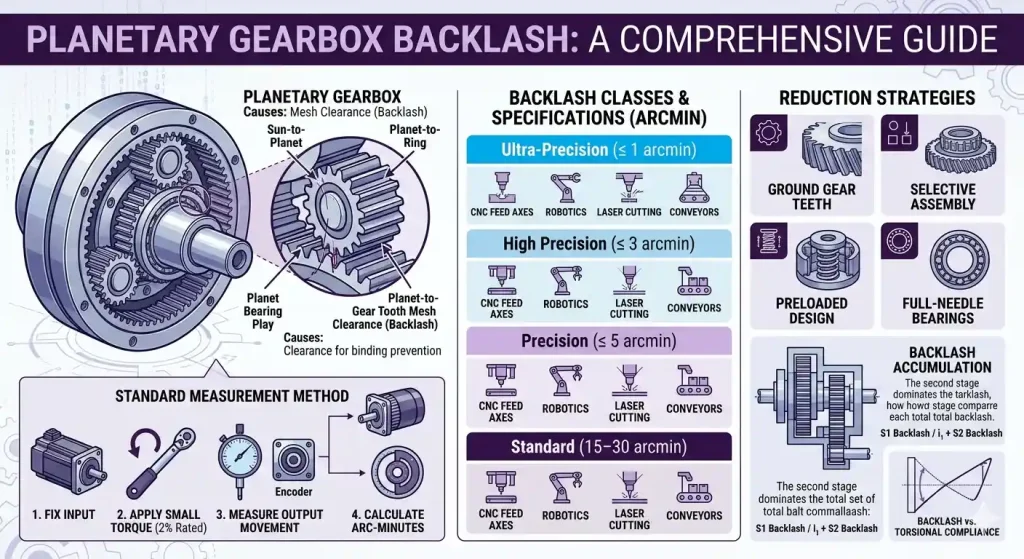
Backlash arises from deliberately designed clearances between gear tooth flanks. A small amount of clearance is necessary in any gear pair — without it, thermal expansion, manufacturing tolerances, and deflection under load would cause gear teeth to bind and seize. The backlash in a planetary gearbox accumulates from three primary sources:
- Sun gear to planet gear mesh clearance: The gap between sun gear tooth flanks and planet gear tooth flanks. This contributes the largest share of total backlash.
- Planet gear to ring gear mesh clearance: The gap at the external-internal gear mesh between planet gears and the fixed ring gear. In high-precision gearboxes, ring gear teeth are often ground to tight tolerances to minimize this contribution.
- Planet carrier bearing play: Radial and axial clearance in the planet pin bearings contributes to apparent backlash at the output when the output shaft rocks under reversal loading.
In standard planetary gearboxes, total backlash is typically 15–30 arcmin. In precision-grade gearboxes, this is reduced to ≤ 3 arcmin, and in high-precision servo gearboxes, ≤ 1 arcmin is achievable through ground gear teeth and selective assembly techniques.
How to Measure Gearbox Backlash
The standard method for measuring backlash at the gearbox output shaft is:
- Fix the input shaft (lock it in position, representing a stationary motor).
- Apply a small torque at the output shaft in one direction (typically 2% of rated output torque, as specified by ISO 9283).
- Record the angular position of the output shaft with a high-resolution encoder or dial test indicator at the output flange.
- Apply the same small torque in the opposite direction.
- The total angular movement at the output shaft is the backlash, typically expressed in arcmin (1 arcmin = 1/60 of a degree).
At a gearbox output shaft radius of 50 mm, 1 arcmin of backlash corresponds to a linear displacement at the shaft periphery of approximately 0.015 mm (15 µm). For CNC machining applications requiring ±5 µm positional accuracy, a gearbox with ≤ 1 arcmin backlash is mandatory.
Backlash Classes and Specifications: Standard vs Precision vs Ultra-Precision
| Grade | Backlash | Typical Applications |
|---|---|---|
| Standard | 15–30 arcmin | Conveyors, mixers, general industrial |
| Precision | ≤ 5 arcmin | Servo axes, rotary tables, packaging |
| High Precision | ≤ 3 arcmin | CNC feed axes, robotics, pick-and-place |
| Ultra-Precision | ≤ 1 arcmin | Laser cutting, semiconductor handling, optical positioning |
Our EP-306 Inline Planetary Gearbox is available in precision and high-precision backlash grades, suitable for demanding servo axis applications where positioning repeatability is critical.
How Manufacturers Reduce Backlash in Precision Planetary Gearboxes
Several design and manufacturing techniques are used to minimize backlash in high-precision planetary gearboxes:
- Ground gear teeth: Grinding gear tooth flanks to tight tolerances (ISO 4–6 quality for precision grades) reduces tooth spacing error and profile deviation, minimizing the tooth flank clearance required to prevent binding.
- Selective assembly: Measuring individual component dimensions and selecting planet gear sets with complementary tolerances achieves tighter backlash than simple tolerance stacking analysis would suggest.
- Preloaded planet carrier design: Some ultra-precision gearboxes use a split planet carrier or spring-loaded preload mechanism that biases all gear meshes in one direction, eliminating the clearance in one mesh direction entirely. This achieves near-zero or zero backlash at the cost of some added drag torque.
- Full-needle roller planet bearings: Replacing standard ball bearings on planet pins with full-complement needle roller bearings reduces radial play and contributes to lower apparent backlash at the output.
Backlash Accumulation in Multi-Stage Gearboxes
In a multi-stage planetary gearbox, backlash accumulates across stages — but not simply by addition. Because the second stage input speed is lower than the first stage input speed, the angular displacement produced by second-stage backlash is magnified by the first stage ratio when referred back to the motor shaft, but is not magnified when referred to the output shaft. The output shaft backlash in a two-stage gearbox is approximately: Output backlash ≈ Stage 1 backlash ÷ i₁ + Stage 2 backlash. This means the second (output) stage dominates the total backlash at the output. Precision gearbox manufacturers typically apply tighter backlash specifications to the output stage for this reason.
Backlash vs Torsional Compliance: Two Different Things
Engineers sometimes confuse backlash with torsional compliance (torsional stiffness). They are distinct: backlash is the free angular movement under zero load, while torsional stiffness describes how much the output shaft deflects angularly under applied torque. A gearbox can have low backlash but low torsional stiffness, or high backlash with high stiffness. For servo applications, both specifications matter: backlash determines reversal dead band, while torsional stiffness determines the natural frequency of the servo system and its ability to reject load disturbances. Consult our inline planetary gearbox datasheets for both backlash and torsional stiffness specifications.
Related Products You May Need
Servo & Stepper Motors
High-resolution encoders on servo motors reveal backlash effects directly — match precision grades.
Electromagnetic Brakes
A holding brake can eliminate position drift due to backlash when the axis is parked under load.
Sprockets & Drive Chains
For non-precision conveyors where standard gearbox backlash is acceptable in the drive chain.
Need a Low-Backlash Planetary Gearbox?
Our precision and ultra-precision planetary gearboxes are available with backlash from ≤ 3 arcmin down to ≤ 1 arcmin — matched to servo, CNC, and robotics requirements.