
When an OEM engineer specifies a planetary gearbox for a new machine design, the output configuration choice — inline (coaxial) versus right angle (bevel output) — is made early in the layout stage and has significant downstream consequences. The wrong choice adds cost, creates installation complications, or forces a machine redesign at a stage where changes are expensive. This guide provides the criteria for making this decision correctly, based on machine geometry, efficiency requirements, and the torque class of the application.
The Core Difference: Shaft Geometry
In an inline planetary gearbox, the input shaft (motor connection) and the output shaft (load connection) share the same centreline. The motor drives in on one axis, and torque is delivered out on the same axis. This coaxial arrangement is mechanically simpler — there is no bevel gear stage required to change direction, which is why inline units have slightly higher efficiency and lower unit cost for the same torque rating.
In a right angle planetary gearbox, a spiral bevel gear set is added at the input or output to redirect the shaft axis by 90°. The motor mounts on one face, and output torque is delivered perpendicular to the motor axis. This allows the motor to be positioned parallel to the load shaft — a layout that is essential for many machine configurations but comes with a small efficiency penalty (typically 1.5–3% per bevel stage) and higher unit cost.
Both configurations are available across the same torque range in our product series. An inline unit (e.g. 311L3) and the equivalent right angle unit (311R3) share the same planetary housing, planet carrier, and ring gear — the difference is the addition of the bevel input stage in the R variant.
 VS
VS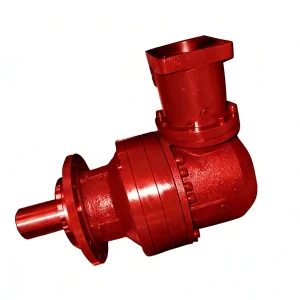
Decision Framework: 5 Questions to Determine the Correct Configuration
If yes: use inline. This is the most common industrial application — conveyor drives, mixer drives, agitators, and any load where the motor can be positioned behind the gearbox along the same centreline. If no (machine geometry requires the motor to be positioned beside or perpendicular to the load shaft): use right angle.
An inline planetary gearbox extends the motor-to-load dimension by the gearbox housing length. In tight machine envelopes where axial space is limited, a right angle unit — where the motor mounts perpendicular to the output shaft — can dramatically reduce the machine’s axial footprint. This is a key advantage in greenhouse ventilation actuators and compact wheel drive assemblies.
For continuous-duty applications running 4,000+ hours per year, the 1.5–3% efficiency difference between inline and right angle translates to a measurable energy cost. At 15 kW continuous, the annual cost difference is approximately $350–700 at $0.12/kWh. If efficiency is critical, use inline. If the right angle geometry is required for machine layout, the cost is typically justifiable.
If replacing a Bonfiglioli, Brevini, or Bosch Rexroth unit, the existing unit’s configuration (L = inline, R = right angle in Bonfiglioli notation; M = inline, D = right angle in Brevini notation) determines the replacement configuration. Do not change from inline to right angle or vice versa without redesigning the motor mount and output shaft interface.
Both inline and right angle configurations are available across the same planetary torque range — from 1,000 Nm through 500,000 Nm in our standard series. The choice between inline and right angle does not constrain the available torque rating. However, for torque above 150,000 Nm, right angle units require larger bevel gear sets and become progressively more expensive relative to inline at the same rating.
Specification Comparison: Side by Side
| Factor | Inline (L / EM / coaxial) | Right Angle (R / ED / bevel) |
|---|---|---|
| Shaft arrangement | Input and output coaxial | Output at 90° to input |
| Typical efficiency | 96–98% per stage | 93–96% (bevel stage loss) |
| Unit cost (same Nm) | Lower | 5–12% higher |
| Axial installation length | Longer (motor behind gearbox) | Shorter (motor perpendicular) |
| Machine layout flexibility | Motor and load must align | Motor can be positioned beside load shaft |
| Torque range available | 1,000 – 500,000 Nm | 1,000 – 500,000 Nm |
Common Applications by Configuration
Inline planetary gearboxes are the standard choice for: industrial conveyors, mixer drives, agitators, winch drum drives (where motor and drum share an axis), pump drives, and any application where the motor can be positioned in line with the load. The majority of replacement orders for Bonfiglioli EM and Brevini EM sub-series are for inline configurations.
Right angle planetary gearboxes are required for: wheel drive applications (where the motor mounts on the hub side and the output flange connects to the wheel), greenhouse rack-and-pinion drives with side-mounted motors, excavator track drives, and any application where the machine layout cannot accommodate an in-line motor-gearbox assembly.
Browse our inline planetary gearbox range and our right angle planetary gearbox range to compare frame sizes, torque ratings, and motor interface options. If your application sits at the boundary between configurations, our engineering team can provide a layout review before you commit to the specification. Send your motor arrangement drawing or describe the machine layout to [email protected] — formal quotations with dimensional drawings for both configurations are available within 24 hours.
Related Searches
inline vs right angle planetary gearbox · coaxial vs bevel planetary gearbox · when to use right angle gearbox · planetary gearbox configuration selection · 311L vs 311R gearbox difference · inline planetary gearbox OEM selection guide
editor:WM